
MCP: Predicting when blood goes bad

Despite the best efforts of blood banks and networks, some blood bags end up spoiling before they can make it to patients in need. A blood bag’s spoilage depends on the red blood cells’ ability to avoid hemolysis caused by low ATP levels. The breaking of red blood cells can release byproducts, such as iron and hemoglobin, that become toxic in a free-floating form by intensifying bacterial infections and interfering with the nitric oxide signaling that is key for vasodilation.
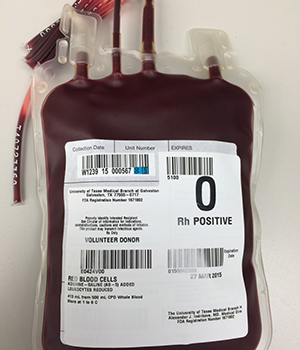 IMAGE COURTESY OF ERIN WEISENHORN
In a paper published in the journal Molecular & Cellular Proteomics, researchers at the University of Wisconsin–Madison have generated a model for predicting post-storage ATP levels in blood based on the concentrations of five key metabolic factors. They found these factors exhibited high heritability and were inherited as a block rather than individually.
“We can use this model to identify blood that can be potentially stored for longer or shorter periods as well as potentially identify other factors to make all blood store longer,” says Erin M. M. Weisenhorn. Weisenhorn, the first author on the paper, is a graduate student in Joshua J. Coon’s group.
To generate this model, the researchers performed a comprehensive metabolomics and proteomics study to examine heritability of metabolites associated with ATP consumption in the red blood cells in 18 pairs of twins. Heritability is the proportion of phenotypic variability due to genetic factors.
The researchers wanted to examine the proteins in the red blood cells’ membranes because of their high abundance there. To do this, they centrifuged the hemoglobin out of whole red blood cells, as it makes up about 98 percent of the cells’ protein content. The researchers digested the remaining proteins with trypsin and subjected them to a novel proteomics and metabolomics approach. The approach involved two sets of liquid chromatography with tandem mass spectrometry, separately optimized for acidic and basic metabolites, combined with a standard analysis by gas chromatography and mass spectrometry. They quantified 328 separate metabolites from the red blood cells, including those from the glycolysis and pentose phosphate pathway.
The researchers then identified 119 membrane proteins and 148 metabolite concentrations that had a heritability rate of more than 30 percent, which previously had been established as a benchmark level of heritability in studies with the same group of twins.
The researchers additionally found that there was a 60 to 90 percent chance of heritability for the entire set of metabolites related to the pathways. “We observe that you don’t just sort of randomly inherit high levels of 2, 3-diphosphoglycerate or pyruvate, but rather that the entire block of metabolites from the intermediate part of the pathway are all inherited at a higher or lower level,” says Thomas J. Raife, a co-author at the UW’s department of pathology and laboratory medicine. “This means a phenotype.”
The researchers proposed phenotypes for both high and low levels of ATP after six weeks of storage. The phenotypes correlated to five key parameters, which include pH and concentrations of phosphofructokinase, an essential enzyme in glycolysis, as well as the proteins Band 3, BPGM and CA1. As a trio, the latter proteins correlated negatively with post-storage ATP conditions, making lower concentrations desirable for blood viability.
This phenotypic existence of varying levels of glycolysis also could have implications for a variety of metabolic diseases, says Weisenhorn. One such correlation is the Warburg effect, in which a cancer is associated with extremely elevated levels of glycolysis. “You can potentially imagine if someone inherits higher levels of these glycolytic proteins or metabolites and has naturally higher flux through this pathway, then they might be more predisposed towards cancer.”
Enjoy reading ASBMB Today?
Become a member to receive the print edition four times a year and the digital edition monthly.
Learn moreGet the latest from ASBMB Today
Enter your email address, and we’ll send you a weekly email with recent articles, interviews and more.
Latest in Science
Science highlights or most popular articles
Mitochondria shape kidney cell function
Researchers at the University of Washington, Seattle present the first quantitative comparison of mitochondrial interactomes between two epithelial cell types in the kidney.
Long-chain polyunsaturated fatty acids linked to postoperative delirium risk
Researchers show that altered lipid metabolism may contribute to postoperative delirium, a condition linked to increased risk for long-term cognitive decline. The study explores potential disease mechanisms, which have yet to be understood.
Glycosylation patterns across antibody isotypes distinguish tuberculosis states
Researchers at Taipei Medical University present the first site-specific glycosylation analysis of immunoglobulins in elderly tuberculosis patients.
Blood glycome possibly predicts lifespan
Researchers at the University of Santiago de Compostela show that total serum N-glycome can predict mortality independent of traditional risk factors.
Building a better model for drug delivery across the blood–brain barrier
Industry and academic scientists collaborated to develop a rat with humanized iron-transport receptors, enabling research into iron homeostasis and drugs that cross the brain’s barrier.
Fat synthesis enzyme crucial for milk fat and newborn growth
Researchers found that a deficiency of the fatty acid synthesis enzyme stearoyl-CoA desaturase-1 reduced mammary gland function during lactation and caused low birth weight in newborns that were fed milk from enzyme-deficient glands.