
Blood proteomics reveals fungal infection signatures for faster diagnosis

Millions of people develop fungal infections each year, some with mortality rates exceeding 90 percent. The fungal pathogen Cryptococcus neoformans has drawn attention from the World Health Organization due to rising cases, severe disease and growing resistance to antifungal drugs. Yet, current diagnostic tools are often slow and offer little insight into how an infection is likely to progress. A recent study published in Molecular & Cellular Proteomics reports protein signatures in C. neoformans that could enable faster diagnosis while also helping predict disease severity.
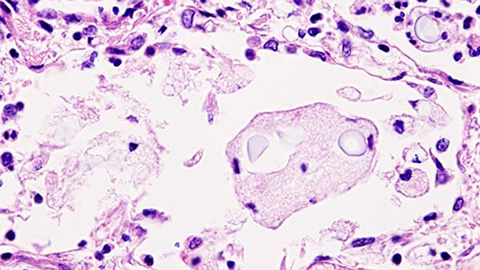
Cryptococcal infections are hard to diagnose early and usually require invasive spinal taps, prompting the search for less burdensome alternatives. To that end, Jennifer Geddes–McAlister, an associate professor at the University of Guelph, and Michael Woods, a doctoral student in her lab, used high-throughput mass spectrometry to track changes in both host and fungal proteins during cryptococcal infection in mice. Over the course of infection, the team identified more than 3,000 host proteins and 160 fungal proteins circulating in the blood. By tracking protein level changes over time, the study provides proof-of-concept that whole-blood proteomics could support diagnosis and prognosis, potentially replacing cerebrospinal fluid sampling.
A key aspect of the project involved Geddes–McAlister’s collaboration with Thermo Fisher Scientific, which provided early access to the Orbitrap Astral Zoom mass spectrometer before its commercial release.
“What makes it a unique or kind of a jump in technology is the speed at which you can detect proteins, and also the depth at which you can detect proteins,” Geddes–McAlister said. “So, you can ask new biological questions and gain new insight into which proteins are changing in those systems.”
The instrument’s increased throughput allowed the team to process 60 blood samples per day, compared with 10 using previous approaches. That efficiency made it possible to capture host–pathogen interactions throughout the course of infection rather than at just a few time points.
“We are really pushing the limits of not only the instrument, but also our biological questions and technology, and what we've applied before,” Geddes–McAlister said. But she said these advances came with challenges, particularly adapting existing methods to a much more powerful instrument. “That was probably the biggest hurdle, was just optimizing what works and what gives us the best coverage without taking too much time.”
The improved efficiency of newer mass spectrometers is especially valuable for studying Cryptococcus, which researchers have long found difficult to analyze. The fungus produces a dense polysaccharide capsule that protects the cells and makes it difficult to break them open and extract proteins, especially from host samples.
Although challenges remain, improved workflows and instrumentation are enabling meaningful progress in protein discovery, which Geddes–McAlister found encouraging.
“I was surprised at the coverage, the number of fungal proteins we identified in the blood,” she said. During graduate school, Geddes–McAlister previously identified only three fungal proteins in blood. “In this study, we identified 160 fungal proteins … it gives us this huge jump, a greater than 50-fold increase from what we had seen before.”
Each newly identified protein represents a potential biomarker that could aid diagnosis or treatment. Geddes–McAlister cautioned that not all 160 proteins identified in the blood are necessarily central to infection or disease progression.
Future work will focus on determining which of these proteins contribute to virulence or alter host immune responses, including studies that remove specific fungal genes. Proteins that play key roles could eventually serve as targets for new antifungal therapies.
Her lab is now building an organ atlas of infection to examine how Cryptococcus interacts with host tissues beyond the bloodstream. This approach will help researchers track how Cryptococcus expression varies across organs during infection, rather than being limited to blood samples.
Enjoy reading ASBMB Today?
Become a member to receive the print edition four times a year and the digital edition monthly.
Learn moreGet the latest from ASBMB Today
Enter your email address, and we’ll send you a weekly email with recent articles, interviews and more.
Latest in Science
Science highlights or most popular articles
Blood glycome possibly predicts lifespan
Researchers at the University of Santiago de Compostela show that total serum N-glycome can predict mortality independent of traditional risk factors.
Building a better model for drug delivery across the blood–brain barrier
Industry and academic scientists collaborated to develop a rat with humanized iron-transport receptors, enabling research into iron homeostasis and drugs that cross the brain’s barrier.
Fat synthesis enzyme crucial for milk fat and newborn growth
Researchers found that a deficiency of the fatty acid synthesis enzyme stearoyl-CoA desaturase-1 reduced mammary gland function during lactation and caused low birth weight in newborns that were fed milk from enzyme-deficient glands.

Flipping lipids and slime molds
A dull first job nearly pushed JBC associate editor Todd Graham out of science. Then a slime mold project changed his path. Now, he studies membrane biology and reflects on discovery, persistence and mentoring through uncertainty.
How smelling death alters worm behavior
Researchers have found that the roundworm C. elegans can smell death, and it changes how the worms behave, reproduce and age.
A chance encounter with the lab
Payton Stevens never planned to become a pancreatic cancer researcher. A temporary job set him on a path from rural Kentucky to leading research on Wnt signaling and metastasis, where he now pairs discovery with mentorship and science advocacy.