
A chance encounter with the lab
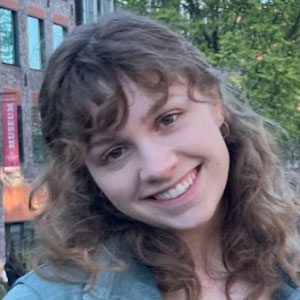
“Happenstance” is how Payton Stevens describes his path to cancer biology.
Growing up in a rural area, Stevens, a first-generation college student, didn’t foresee a career as a pancreatic cancer researcher. An avid fisherman and hiker, he gravitated toward nature and evolution.
Although he would eventually build a career in the lab, Stevens had never heard of research as a profession. He followed his interest in science to the University of Kentucky, earning a bachelor’s degree in biology. By his senior year, he had discovered a passion for cancer biology, even if a career in the field felt out of reach.
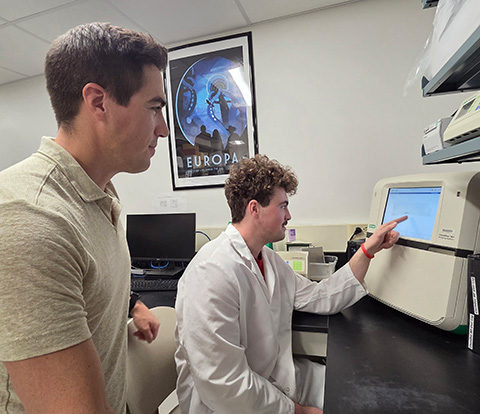
“It didn't really seem like something that was approachable by me,” Stevens, now an assistant professor of biological sciences at Miami University, said.
A chance introduction to a research lab changed that perception. In 2008, amid a struggling economy, jobs and graduate school placements were scarce. Through a college friend, Stevens snagged a part-time lab job at the Markey Cancer Center. That opportunity turned into a four-year role as a research analyst.
Studying phosphatases in colon cancer and developing his own projects, Stevens began to gain confidence in the lab.
“Once I got in there, I realized it's sort of like a puzzle,” Stevens said. “You're just solving it one piece at a time.”
Four years immersed in cancer biology cemented his plan to pursue a lab-based career. Encouraged by his principal investigator, Tianyan Gao, he applied to graduate school. He did not have to move far: Stevens stuck with the University of Kentucky, where he continued studying colon cancer. He earned a doctorate in molecular and cellular biochemistry after four years of studying how protein kinase B, or AKT, and mitogen-activated protein, or MAP, kinase signaling influence colon cancer cell motility.
For his postdoctoral training, Stevens set out to broaden his scientific scope. At the Van Andel Institute, he connected with Bart Williams, an expert in Wnt signaling, a form of cell communication that influences cell movement. Williams told him he could pursue any project, as long as it was related to Wnt signaling, a directive that gave Stevens wide creative latitude.
Stevens dove into the literature. After some digging, he discovered that certain Wnt receptors were upregulated in some late-stage pancreatic cancers. Pancreatic cancer was a compelling target: this highly lethal form of cancer often progresses aggressively, leaving urgent gaps in treatment.
“To have the largest effect on impacting patient outcomes, that's where I want to focus my efforts,” Stevens said. “I want to have the biggest impact that I can.”
Over the next five years, he explored the understudied relationship between Wnt signaling and pancreatic cancer, shifting from AKT and MAP kinase pathways in colon cancer to Wnt-driven metastasis in pancreatic cancer.
“The consistency there was I was still focused on metastasis and cell motility,” Stevens said. “I still had some overlap.”
Building a lab at Miami University
Beyond expanding his research horizons, Stevens’s postdoctoral years also sparked an interest in teaching. He eventually brought his Wnt research to Miami University, where he now balances roles as educator and researcher.
Within the complex Wnt signaling network, Stevens’s lab focuses on a noncanonical pathway that directs cell movement during embryonic development. This pathway acts like a GPS, guiding cells to their correct destinations. Noncanonical Wnt pathways are responsible for this cell migration, whereas canonical Wnt pathways regulate cell differentiation.
His team aims to identify the exact ligands and receptors involved and determine how cancer cells may hijack the pathway. Although largely inactive in healthy adult tissue, Stevens suspects that the pathway may be reactivated in cancer, increasing tumor cell motility and driving metastasis. His lab was among the first to examine the role of this understudied noncanonical pathway in pancreatic cancer.
Mentorship and access
Stevens might have landed his dream career, but he didn’t always see it as an achievable possibility. That’s something he wants to change.
“I don't want people from underprivileged backgrounds thinking that this is something that is too daunting for them to do,” Stevens said. “(T)hat's sort of what I thought, and it took getting experience to break (through) that.”
He embeds that philosophy into his mentorship, which he said is based on pragmatism. He encourages trainees to set practical career goals, build concrete action plans and position themselves to thrive in fields they find meaningful.
Stevens also advocates for consistent federal investment in science. Stable funding, he says, signals to trainees that science is a viable career and strengthens U.S. leadership in research. Stevens serves on the American Society for Biochemistry and Molecular Biology’s Public Affairs Advisory Committee, which works to expand access to science and research careers. In that role, he pushes for evidence-based policy and even meets with lawmakers to discuss research funding.
Above all, Stevens is an advocate for students. Although he stumbled into research, Stevens now works to make those opportunities intentional for others.
“I want everyone to succeed,” he said. “It was very happenstance that I fell into my career, and I know that not everybody’s so lucky.”
Enjoy reading ASBMB Today?
Become a member to receive the print edition four times a year and the digital edition monthly.
Learn moreGet the latest from ASBMB Today
Enter your email address, and we’ll send you a weekly email with recent articles, interviews and more.
Latest in People
People highlights or most popular articles
ASBMB members receive ASPET awards
The American Society for Pharmacology and Experimental Therapeutics awards Simone Brixius–Anderko, Paul Insel, Sudarshan Rajagopal, Emily Scott, Alan Smrcka and Jürgen Wess for their excellent research and mentoring work in pharmacology.
Kozul honored by Washington University
She received the 2025 Elliot L. Elson Education and Training Award.
de la Fuente honored for AI research
The award will support the development of an AI system called ApexMol, a 3D structure–informed, agentic large language model designed to create new biomolecules.
In memoriam: Peter Roepstorff
He was a leading researcher in biological mass spectrometry, mapped protein function in living organisms and was an ASBMB member for 19 years.
Flipping lipids and slime molds
A dull first job nearly pushed JBC associate editor Todd Graham out of science. Then a slime mold project changed his path. Now, he studies membrane biology and reflects on discovery, persistence and mentoring through uncertainty.
ASBMB members receive RNA Society awards
The RNA Society awards Brenda Bass, Can Cenik and Karin Musier–Forsyth for their achievements in RNA research and innovation. Winners will be recognized at the closing awards ceremony of the RNA 2026 annual meeting.