
How smelling death alters worm behavior
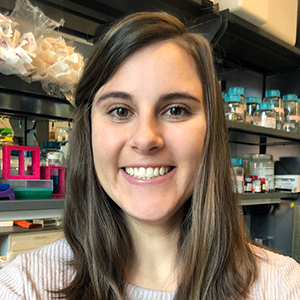
Dead bodies rarely go unnoticed in nature; many animals change their behavior when they encounter death. A recent study from Matthias Truttmann showed that even the microscopic nematode Caenorhabditis elegans can detect dead neighbors — a perception that reshapes its behavior, reproduction and lifespan.
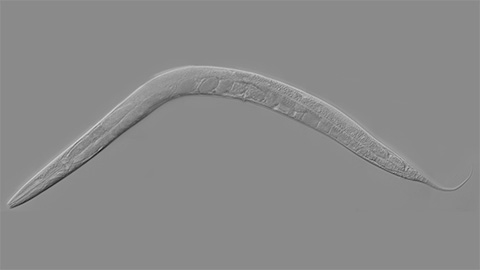
Truttmann, an assistant professor at the University of Michigan Medical School, studies how protein homeostasis is regulated during aging and aging-related diseases using C. elegans as a model. During experiments exposing C. elegans to bacterial pathogens, Truttmann observed that worms typically respond with strong aversion and attempt to escape — yet, many succumb to infection.
“A student asked me if the accumulated worm corpses might contribute to the observed aversive response,” Truttmann said. “I had no answer to offer.”
At the same time, Truttmann’s next-door colleague Scott Pletcher, a professor of physiology, observed that the presence of dead flies could shorten the lifespan of living flies. Together, these observations prompted Truttmann’s group to test whether worms also respond to death in their environment.
Sensory cues
By performing simple observational studies, the team found that living worms actively avoid areas containing dead worms, regardless of their age, sex or feeding status. Exposure to dead worms shortened lifespan, reduced physical fitness and briefly increased egg laying — a shift that prioritizes reproduction over longevity.
To understand how worms sense death, the team designed experiments to test both smell and touch. Living worms avoided food even when dead worms were suspended above them, out of reach.
“These experiments showed that an olfactory cue is sufficient to induce avoidance behavior in response to dead conspecifics,” Truttmann said.
The researchers traced the sensory pathway responsible for detecting death. Two chemosensory neurons, AWB and ASH, proved essential. When these neurons were disabled, worms neither avoided death-associated cues nor showed the usual declines in health and lifespan.
Smelling death
To determine what the worms were detecting, the team chemically analyzed corpse extracts and identified two unexpected molecules: adenosine monophosphate, or AMP, and the amino acid histidine. When added individually, AMP or histidine alone triggered avoidance behaviors in worms.
While both molecules are abundant inside living cells and released when tissues break down, they are not inherently volatile — a puzzle for the team.
“We did not expect to identify AMP and histidine as potential cues involved in death perception,” Truttmann said. “We cannot explain how these two molecules could serve as olfactory cues.”
The team also observed that C. elegans avoided corpses from other species, including flies. This hints at a conserved death signature across species and adds to the evidence that sensory perception can shape physiology.
While the team identified some death-associated cues, Truttmann plans to continue this line of research. The initial observations suggest that death isn’t just an endpoint but can also act as a signal that influences the living.
“We’d like to work out more details on the signal that is perceived by the worms and recognized as an indicator of corpses in their environment,” he said. “The cues we identified, while contributing, might not be the whole story.”
Enjoy reading ASBMB Today?
Become a member to receive the print edition four times a year and the digital edition monthly.
Learn moreGet the latest from ASBMB Today
Enter your email address, and we’ll send you a weekly email with recent articles, interviews and more.
Latest in Science
Science highlights or most popular articles
Long-chain polyunsaturated fatty acids linked to postoperative delirium risk
Researchers show that altered lipid metabolism may contribute to postoperative delirium, a condition linked to increased risk for long-term cognitive decline. The study explores potential disease mechanisms, which have yet to be understood.
Glycosylation patterns across antibody isotypes distinguish tuberculosis states
Researchers at Taipei Medical University present the first site-specific glycosylation analysis of immunoglobulins in elderly tuberculosis patients.
Blood glycome possibly predicts lifespan
Researchers at the University of Santiago de Compostela show that total serum N-glycome can predict mortality independent of traditional risk factors.
Building a better model for drug delivery across the blood–brain barrier
Industry and academic scientists collaborated to develop a rat with humanized iron-transport receptors, enabling research into iron homeostasis and drugs that cross the brain’s barrier.
Fat synthesis enzyme crucial for milk fat and newborn growth
Researchers found that a deficiency of the fatty acid synthesis enzyme stearoyl-CoA desaturase-1 reduced mammary gland function during lactation and caused low birth weight in newborns that were fed milk from enzyme-deficient glands.

Flipping lipids and slime molds
A dull first job nearly pushed JBC associate editor Todd Graham out of science. Then a slime mold project changed his path. Now, he studies membrane biology and reflects on discovery, persistence and mentoring through uncertainty.