
Rounding out the year with nickel and zinc

To complete our celebration of the 150th anniversary of Dmitri Mendeleev’s periodic table, we look at nickel and zinc, two metallic elements with chemical symbols Ni and Zn and atomic numbers 28 and 30, respectively.
 This ribbon diagram shows the 3D structure of the enzyme urease in coordination with two nickel ions depicted in green.E. Jabri et al/Wikimedia Commons
Nickel can exist in oxidation states ranging from -2 to +4. The most abundant — Ni+2 — combines with common anions such as sulfate, sulfide, carbonate, nitrate and hydroxide. In contrast, zinc predominates in the oxidation +2 almost exclusively, acting as a strong reducing agent. Zinc forms binary compounds with most nonmetal and metalloid elements with the exception of noble gases.
Nickel is produced with iron in the final stages of nuclear reactions during violent explosions deep inside supergiant stars. As a result, these two elements are mixed abundantly in the interior of meteorites. The astrophysical origin of zinc is not entirely understood, but it might have involved the asymmetric explosion of the universe’s earliest supernova.
Nickel makes up only 0.008% of the Earth’s crust and occurs often as an alloy with iron in the planet’s core. It also exists in minerals in combination with sulfur and arsenic. Zinc is the 24th most common element in the Earth’s crust, where it is found primarily as zinc sulfide and as a binary alloy with metals including aluminum, gold, iron, lead, silver and nickel. Mineral weathering disperses small amounts of zinc into soil, seawater and the atmosphere.
Both nickel and zinc are essential for life and are present in many organisms. Nickel is recognized and transported into the cell by a variety of mechanisms: nonspecific influx across membrane proteins in bacteria and yeast, high-affinity uptake via transporters and permeases in certain bacteria, and incorporation through channels that preferentially carry other divalent cations — such as magnesium and calcium — in fungi and humans. Inside cells, nickel is inserted into the active site of many enzymes such as hydrogenase, nickel superoxide dismutase, carbon monoxide dehydrogenase, cis-trans isomerase and urease. Toxic excess intracellular free nickel is neutralized by binding to negatively charged molecules such as polyphosphate and sequestration of nickel-containing complexes into vacuoles.
The nickel-containing protein urease is important in the pathophysiology of liver cirrhosis, peptic ulcers and urinary stones. Urease is produced by bacteria that infect the gastrointestinal and urinary tracts, including Helicobacter pylori and Proteus mirabilis. It breaks down urea and produces ammonia, which increases the pH of the surrounding environment from neutral to basic and becomes toxic in the liver, the stomach lining, the kidneys and the blood stream.
Cells transport, use and sequester zinc much as they do other divalent metals. Photosynthetic bacteria of the genus Acidiphilium contain a purple chlorophyll pigment that uses zinc as cofactor instead of the more common magnesium. Zinc-dependent phospholipases C in Clostridia, Bacillus or Listeria species may contribute to toxicity by breaking down host cell membranes. The coordination of one or more zinc ions by particular amino acids forms a zinc-finger motif that stabilizes the 3D structure of many proteins that bind DNA, such as nucleases and transcription factors.
A year of (bio)chemical elements
Read the whole series:
For January, it’s atomic No. 1
For February, it’s iron — atomic No. 26
For March, it’s a renal three-fer: sodium, potassium and chlorine
For April, it’s copper — atomic No. 29
For May, it’s in your bones: calcium and phosphorus
For June and July, it’s atomic Nos. 6 and 7
Breathe deep — for August, it’s oxygen
Manganese seldom travels alone
For October, magnesium helps the leaves stay green
Enjoy reading ASBMB Today?
Become a member to receive the print edition four times a year and the digital edition monthly.
Learn moreGet the latest from ASBMB Today
Enter your email address, and we’ll send you a weekly email with recent articles, interviews and more.
Latest in Science
Science highlights or most popular articles
Fat synthesis enzyme crucial for milk fat and newborn growth
Researchers found that a deficiency of the fatty acid synthesis enzyme stearoyl-CoA desaturase-1 reduced mammary gland function during lactation and caused low birth weight in newborns that were fed milk from enzyme-deficient glands.
Flipping lipids and slime molds
A dull first job nearly pushed JBC associate editor Todd Graham out of science. Then a slime mold project changed his path. Now, he studies membrane biology and reflects on discovery, persistence and mentoring through uncertainty.
How smelling death alters worm behavior
Researchers have found that the roundworm C. elegans can smell death, and it changes how the worms behave, reproduce and age.
A chance encounter with the lab
Payton Stevens never planned to become a pancreatic cancer researcher. A temporary job set him on a path from rural Kentucky to leading research on Wnt signaling and metastasis, where he now pairs discovery with mentorship and science advocacy.

Light-activated small molecule could transform eye infection treatment
Contact lenses raise the risk of infectious keratitis, a leading cause of blindness worldwide. A biotech company is commercializing a light-activated therapy using a ROS-generating molecule to rapidly kill microbes in the cornea to preserve vision.
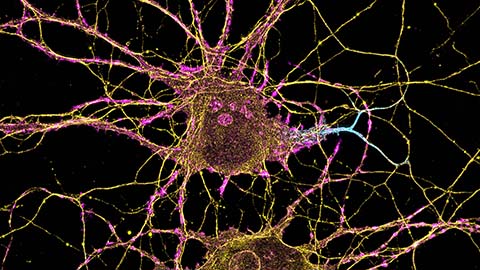
The molecular orchestra of memory
Calcium, calmodulin and calcium/calmodulin-dependent kinase II form a molecular axis that turns fleeting neural activity into lasting memories. New research shows how memories are stabilized, and possibly even protected or repaired.