
When AI replaces confidence in the classroom

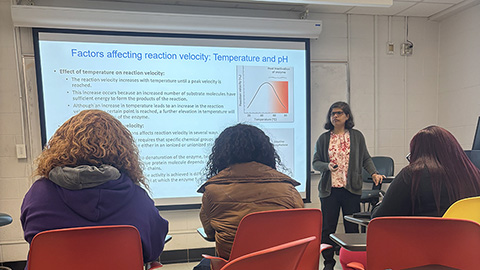
When I walked into my upper-level undergraduate molecular biology classroom this past fall, I sensed a shift in the atmosphere. Some students scrolled through their phones; others wore headphones and several talked with classmates instead of focusing on the lecture. Their disengagement made me anxious about how the semester would unfold and how best to support them.
I teach at a historically Black university where more than 80 percent of students identify as African American. My students are highly ambitious, yet many arrive after navigating unequal educational opportunities that affect their preparation and confidence.
Many balance full-time work, caregiving responsibilities or the challenges of being first-generation college students without established role models.
What may appear as disengagement often reflects competing demands or anxiety about participating in rigorous STEM environments.
The students’ first major assignment was part of a semester-long project culminating in a National Institutes of Health–style specific aims page on a gene of interest. For this assignment, they synthesized molecular biology literature and wrote a two-paragraph background and introduction section that would later feed into the final specific aims page.
Although the syllabus prohibited artificial intelligence use and required authentic student effort, many early submissions fabricated references and unverifiable claims. I confirmed this by cross-checking article titles and DOIs in Google Scholar and PubMed.
Some citations listed nonexistent authors, inaccurate titles or incorrect journal information, making the articles impossible to locate. These discrepancies indicated that a significant portion of the class relied on AI-generated text despite the policy.
Even after the opportunity to revise for partial credit, several students continued to violate the policy.
This behavior reflected more than rule-breaking. It revealed uncertainty about how to read scientific papers, interpret findings and communicate ideas independently. AI became an appealing shortcut for students overwhelmed by scientific writing.
Instead of supporting learning, AI became a barrier.
This raised important questions: How can instructors promote critical thinking when instant answers feel easier? How do we build confidence in scientific reasoning when many students are unsure how to begin? How do we enforce academic integrity without discouraging students who already feel overwhelmed?
AI also introduces new challenges for faculty. Identifying fabricated content requires time and careful review, and supporting students while maintaining academic standards demands patience and thoughtful communication.
Because addressing academic integrity concerns can affect student evaluations, this creates a professional dilemma for untenured faculty whose advancement depends on them. I feel this pressure strongly because I am on an accelerated tenure timeline, where early teaching evaluations can significantly influence career advancement.
To respond constructively, I incorporated a complementary group assignment designed by a senior colleague. Students created a podcast explaining the molecular biology of their chosen gene and its disease relevance. This format encouraged collaboration, conversation and interpretation in their own voices.
The shift was immediate.
Students who struggled to write became expressive in discussion. They asked thoughtful questions and connected ideas with confidence. One group turned their gene into a rap performance, blending signaling pathways and molecular function into the verses and demonstrating genuine understanding of the Apolipoprotein E gene through scientifically accurate lyrics grounded in primary literature.
AI is now part of the educational landscape, and this experience showed me that students need guidance on using it responsibly. They also need assignments that promote authentic engagement and strengthen confidence in their reasoning.
Teaching at a historically Black university has reinforced the importance of empathy, patience and adaptability while maintaining high standards. In addition to discussion-based assignments, instructors can deter improper AI use by allowing limited AI use when students cite it and identify and correct errors before final submission.
Ultimately, the goal is not to eliminate AI from the classroom but to help students think independently and critically in an AI-enabled world.
Enjoy reading ASBMB Today?
Become a member to receive the print edition four times a year and the digital edition monthly.
Learn moreGet the latest from ASBMB Today
Enter your email address, and we’ll send you a weekly email with recent articles, interviews and more.
Latest in Opinions
Opinions highlights or most popular articles
Learning can be fun: Gaming anatomy and physiology
Instructors explore how gamification and active learning transform student engagement and retention. They convey how emotion, interaction and design can make even rigorous subjects more effective and memorable.
Mentorship and uncertainty: Lessons from Telemachus
A biochemistry educator reflects on mentorship through the Greek story of Telemachus, showing how embracing uncertainty, failure and curiosity can transform teaching.
Embracing the twists and turns along the educator pathway
A biochemistry educator reflects on the challenges of early faculty life, describing how evidence-based teaching, cross-disciplinary collaboration and classroom challenges shaped her growth.
Redesigning with students in mind
Assistant professor reflects on how the shift to online teaching revealed gaps in points-based grading and led to a redesign centered on transparency and student growth.
Teaching beyond information transfer
Educator reflects on moving beyond lectures to create a biochemistry classroom centered on engagement, transparency and student ownership, showing how small shifts like “student hours” and active learning can transform understanding.
Mayday! Lessons from cellular dysfunction and group work dynamics
An upper-level biology course revealed that strong science doesn’t guarantee strong teamwork. One instructor shares how failed group dynamics reshaped their approach, leading to more structured, collaborative and effective student learning.