

When biochemistry stopped being scary
Teaching, for me, did not begin as an act of confidence. It began with a question:
Why are so many students afraid of biochemistry?
Early in my career, I noticed a troubling pattern. Students did not merely find biochemistry difficult; they avoided it. They described it as abstract and dry, overloaded with pathways and names detached from meaning. Many had already decided, before entering the classroom, that biochemistry was something to “survive,” not to understand.
Entering academia as a woman in a resource-limited region, I was already familiar with barriers such as limited funds, institutional inertia and the quiet skepticism that often greets young female faculty. Watching students retreat from a subject that explains life at its most intimate level felt like a deeper loss.
If biochemistry is the language of living systems, why had it become a language of fear?
At first, I followed the conventional path: slides, textbooks, diagrams and exams.
The more I taught, the more I sensed that the problem was not students’ ability but our mode of translation. We were presenting a three-dimensional, dynamic molecular world through flat images and rushed lectures, expecting wonder to emerge automatically.
I wanted to change that.
I tried to access educational tools, molecular models, kits and manipulatives, anything that could bring molecules into students’ hands. Financial constraints were real. Institutional support was limited, and innovation was often discouraged.
I was advised to “focus on finishing the syllabus,” “maintain decorum” and “avoid experimentation.”
When I finally managed to acquire a small set of physical models, they were later stolen.
It felt symbolic. Every time I tried to build something new, something seemed to pull it back into absence.
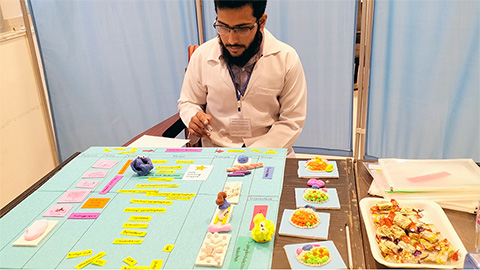
Gradually, I began building my own models and discovered a capacity for creative design I did not know I had. Cardboard, clay, magnets, beads, flexible wires and pipe cleaners. Using whatever I could find, I built molecular models students could hold and assemble.
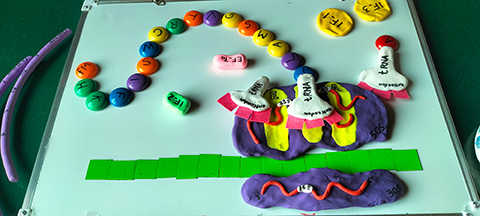
I created pathway puzzles, hormone-signaling Rube Goldberg machines, metabolic board games and immune receptor kits. Not as “extras,” but as central teaching tools.
If biochemistry is about interactions, flows and transformations, students should be able to touch them.
That decision changed everything.
My classroom slowly transformed into a workshop. Students stopped asking, “Will this be on the exam?” and started asking, “Can we try this again?”
They delved deeper into pathways, simulated disease models and built receptors. They failed, adjusted, laughed and tried again.
I was no longer the only one explaining biochemistry; the room itself became part of the explanation.
What surprised me most was not just improved understanding, but a shift in emotional state. Fear softened into curiosity, silence into debate and memorization into ownership.
Word spread.
As an external examiner, I began carrying these games and models to medical colleges across Pakistan. The first reaction was almost always the same: nervous smiles, stiff posture and the expectation of judgment.
But, when I invited students to assemble, compete, diagnose and design, the room changed. Hands rose, laughter broke out and groups formed. I watched students who believed they “couldn’t do biochemistry” suddenly teach it to each other.
Those students taught me something essential: engagement is not decoration. It is cognition. What began as a solitary effort became a collaborative one. Through sustained feedback and classroom interaction, the models evolved into tools co-created with my students.
Looking back, my teaching did not evolve because I discovered a better technique. It evolved because I refused to accept a myth: that biochemistry is inherently boring and hard.
It is neither.
It is visual, mechanical, logical and alive. When we design learning environments that honor those qualities, students do not run from biochemistry. They run toward it.
Every time I watch that happen, I am reminded that teaching is not the transfer of knowledge. It is the continuous redesign of the conditions under which wonder becomes possible.
Enjoy reading ASBMB Today?
Become a member to receive the print edition four times a year and the digital edition monthly.
Learn moreGet the latest from ASBMB Today
Enter your email address, and we’ll send you a weekly email with recent articles, interviews and more.
Latest in Opinions
Opinions highlights or most popular articles
Learning can be fun: Gaming anatomy and physiology
Instructors explore how gamification and active learning transform student engagement and retention. They convey how emotion, interaction and design can make even rigorous subjects more effective and memorable.

Mentorship and uncertainty: Lessons from Telemachus
A biochemistry educator reflects on mentorship through the Greek story of Telemachus, showing how embracing uncertainty, failure and curiosity can transform teaching.
Embracing the twists and turns along the educator pathway
A biochemistry educator reflects on the challenges of early faculty life, describing how evidence-based teaching, cross-disciplinary collaboration and classroom challenges shaped her growth.
Redesigning with students in mind
Assistant professor reflects on how the shift to online teaching revealed gaps in points-based grading and led to a redesign centered on transparency and student growth.
Teaching beyond information transfer
Educator reflects on moving beyond lectures to create a biochemistry classroom centered on engagement, transparency and student ownership, showing how small shifts like “student hours” and active learning can transform understanding.
Mayday! Lessons from cellular dysfunction and group work dynamics
An upper-level biology course revealed that strong science doesn’t guarantee strong teamwork. One instructor shares how failed group dynamics reshaped their approach, leading to more structured, collaborative and effective student learning.