

Learning can be fun: Gaming anatomy and physiology


The goal of learning is retention. Retention, according to neuroscientists, is the process of encoding, storing and retrieving information for future use. Enhancing retention is central to education. Students must remember what they learn to succeed on exams and apply that knowledge later in their careers.
Yet, many educational systems still prioritize information exposure over retention. Students are often overwhelmed with content while retaining little of it.
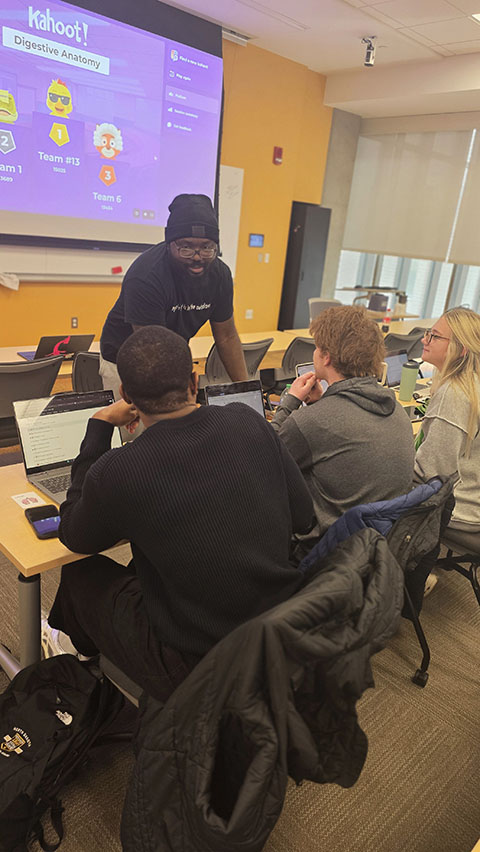
This was the experience of one of us, an international student from Nigeria. This educational background in physiology was shaped by long essays, dense materials and a strenuous learning process. The learning environment was rigorous and rarely enjoyable, making endurance essential for retention.
My perspective shifted in fall 2025 when I worked as a teaching assistant in an anatomy and physiology class. In a cardiovascular physiology class, I won a 3D-printed heart in a competition to name terms from the course. I enjoyed the competition and how engaging it was for students. This experience taught me that learning does not have to be painful or boring to be effective.
When learning is engaging, retention improves. In redesigning courses around flipped, active learning, this pattern became clear: when students are engaged, content is more likely to stick, though creating that engagement is often complex.
One way we increased engagement was through gamification, the application of game elements to other contexts. We believe this works because learning combines information with experiences and emotions, helping the brain form connections that support memory. A key element of gaming is its impact on engagement and motivation, which supports learning and retention.
It is important to note that adding gamified elements does not reduce rigor. In STEM education, especially, we often equate seriousness with effectiveness, expecting students to immerse themselves in demanding content at the expense of enjoyment. While the knowledge and skills they gain are critical, they do not have to come at the cost of joy. In fact, research suggests the opposite: emotions play a central role in how students engage with and retain information.
These emotional connections can act as natural bookmarks. For example, a smell can trigger a memory, or a sound can recall a specific moment, helping encode and retrieve memories. The more varied these bookmarks are, the stronger the retention becomes. Gaming reinforces learning by making the brain more reward-driven, leading to conditioned behaviors supported by these synaptic “bookmarks.”
Yet, many learning environments fail to use this natural system.
Passive lectures provide few cognitive anchors for the brain. When students struggle, the blame is often placed on their discipline or motivation. Yet, these same students master complex video games, learn evolving rules and retain vast amounts of information.
Why doesn’t this translate to the classroom?
We believe game-like elements can leverage the brain’s strengths. Presenting information in a repetitive, stepwise, challenging and collaborative way, with feedback and rewards, gives the brain multiple bookmarks that reinforce learning.
In the course, Dr. Haage intentionally embedded gamified learning into the curriculum. This included crosswords to reinforce terminology and a “Connection+” game in which students matched terms within physiological systems. Students also created their own games as part of the assignment. Team-based challenges like Jeopardy! further encouraged collaboration and healthy competition.
These activities promoted active learning, and students became more engaged in class discussions. Students reported that gamification improved retention. This showed that gamification does not reduce rigor but enhances it by aligning teaching with how the brain learns.
However, this approach comes with challenges. Designing and implementing active learning and custom games requires substantial time and effort, often more than delivering a traditional lecture. There can be student resistance, often reflecting assumptions about what “serious” learning should look like. To foster lifelong learning and support deep engagement, retention and application, we must intentionally engage students’ emotions.
Learning can and should be fun. By embracing the science behind gamification, especially in demanding subjects like anatomy and physiology, educators can improve retention. It is time to move beyond content delivery toward lasting retention.
Enjoy reading ASBMB Today?
Become a member to receive the print edition four times a year and the digital edition monthly.
Learn moreGet the latest from ASBMB Today
Enter your email address, and we’ll send you a weekly email with recent articles, interviews and more.
Latest in Opinions
Opinions highlights or most popular articles
Mentorship and uncertainty: Lessons from Telemachus
A biochemistry educator reflects on mentorship through the Greek story of Telemachus, showing how embracing uncertainty, failure and curiosity can transform teaching.
Embracing the twists and turns along the educator pathway
A biochemistry educator reflects on the challenges of early faculty life, describing how evidence-based teaching, cross-disciplinary collaboration and classroom challenges shaped her growth.
Redesigning with students in mind
Assistant professor reflects on how the shift to online teaching revealed gaps in points-based grading and led to a redesign centered on transparency and student growth.
Teaching beyond information transfer
Educator reflects on moving beyond lectures to create a biochemistry classroom centered on engagement, transparency and student ownership, showing how small shifts like “student hours” and active learning can transform understanding.
Mayday! Lessons from cellular dysfunction and group work dynamics
An upper-level biology course revealed that strong science doesn’t guarantee strong teamwork. One instructor shares how failed group dynamics reshaped their approach, leading to more structured, collaborative and effective student learning.
Showing students that it’s OK to ask questions
Assistant professor reflects on how admitting uncertainty and following student questions beyond the syllabus reshaped classroom culture, encouraging curiosity, vulnerability and deeper engagement in introductory biology.