
Which eight escaped the Scientific 16?
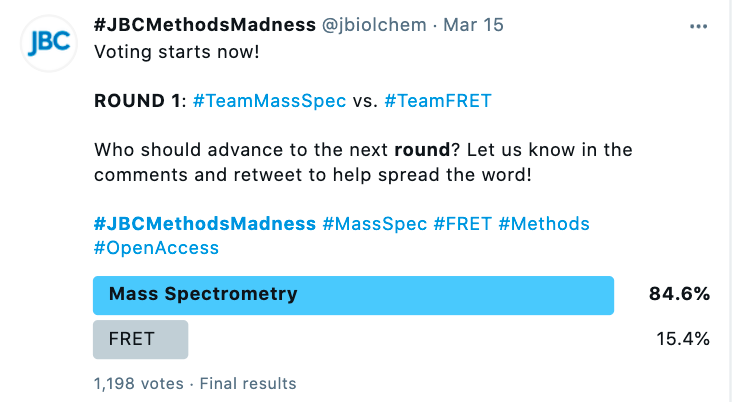
The Journal of Biological Chemistry’s Methods Madness tournament started off with a bang as last year’s finalist, #TeamMassSpec, faced off against the tournament newcomer #TeamFRET. #TeamFRET fought valiantly, but their supporters’ energy just didn’t transfer into votes. Meanwhile, #TeamMassSpec supporters turned up in SPECTRAcular numbers, pushing their team to the next round.
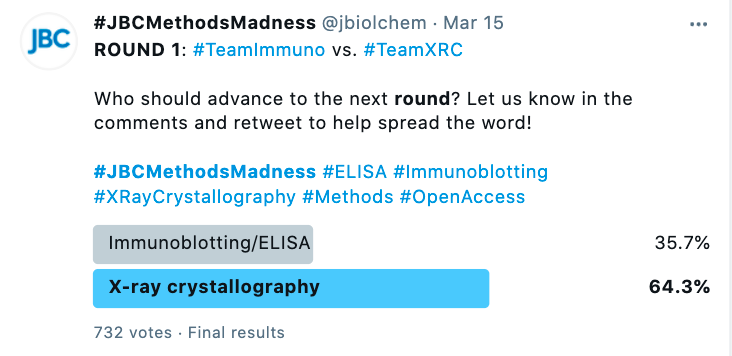
X-ray crystallographers around the world are rejoicing after #TeamXRC’s victory over #TeamImmuno. Votes proved to be too nonspecific for #TeamImmuno, whose supporters were unable to band together to provide support for their team. #TeamXRC advances to the next round while #TeamImmuno fades into the background.
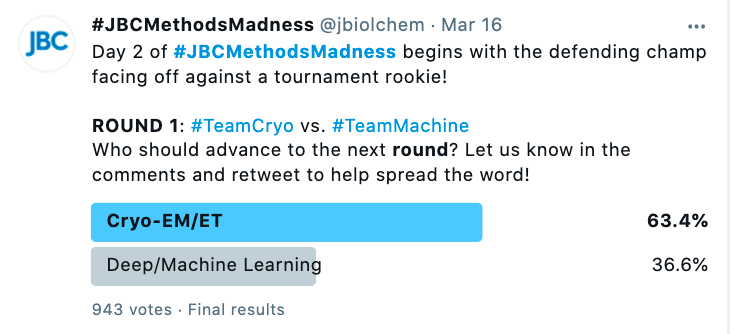
#TeamCryo iced their competition, leaving #TeamMachine frozen in their tracks. Despite strategic support from #TeamMassSpec, it seems too many #TeamMachine supporters had their heads in the cloud, because they couldn’t find the algorithm needed to execute a win against the defending champion. #TeamCryo will move on to the Energetic Eight, where they will have a tough matchup against #TeamCRISPR.
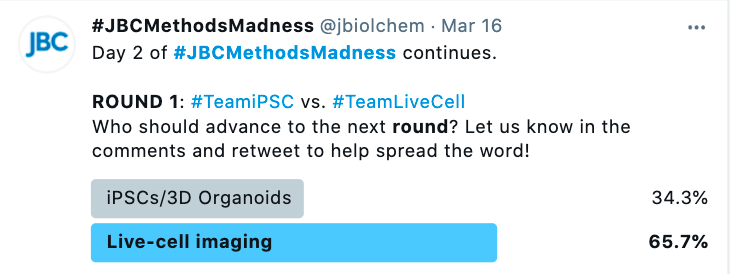
In this cellular showdown, #TeamiPSC lacked the factors necessary to differentiate from the other losers of the week. In contrast, #TeamLiveCell was unphased by the pressure, shining bright in the win they captured. #TeamLiveCell has #TeamOmics in their frame as they focus on the next round.
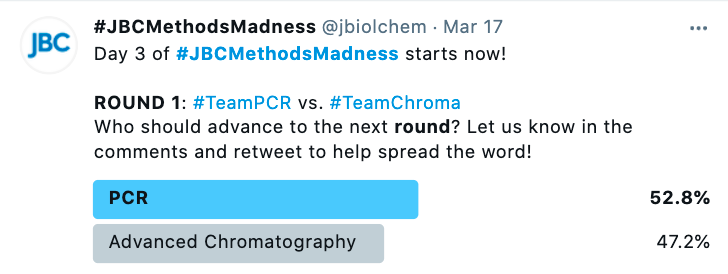
#TeamPCR copied last year’s success to defeat #TeamChroma and advance to the next round. Supporters of #TeamChroma couldn’t match the flow rate of #TeamPCR voters, leaving #TeamChroma stuck in a stationary phase while their opponent mobilized. #TeamPCR will look to amplify their success with a win over #TeamMassSpec in the next round.
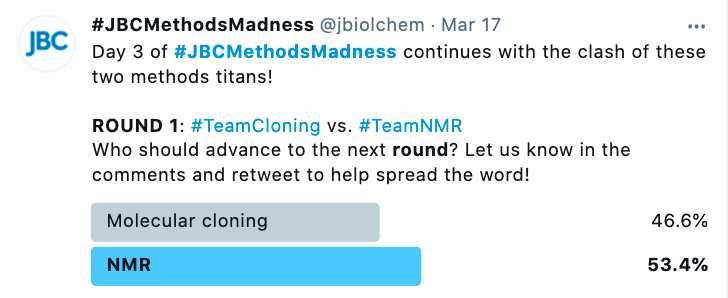
Resonating with their supporters, #TeamNMR put forth a dynamic performance to secure their second #JBCMethodsMadness win in as many years. Living up to their name, #TeamCloning replicated last year’s performance where they also lost against #TeamNMR in the first round. Perhaps they’ll find the winning recombination next year!
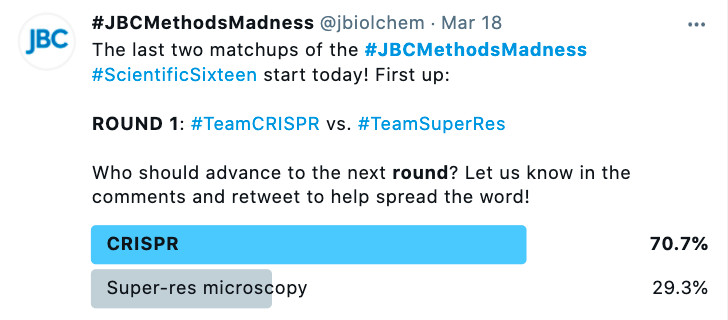
#TeamCRISPR excised #TeamSuperRes in the first round of the tournament and will move on to the next round. Despite their resolution to make it further this year, the win that #TeamSuperRes pictured was never fully deconvolved. #TeamCRISPR has their work cut out for them, facing off against the defending champion #TeamCryo.
Seq-ing a win in their tournament debut, #TeamOmics analyzed their competition and came out victorious. Seemingly unable to shed light on a winning formula, #TeamOpto failed to excite their supporters, resulting in their second tournament loss in as many years. Next, #TeamOmics will match up against #TeamLiveCell in the Energetic Eight round.
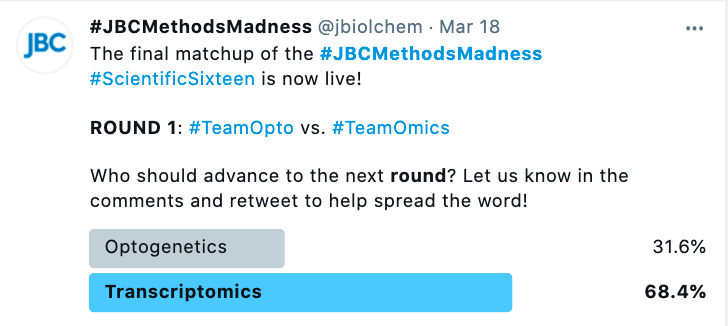
Round 2: The Energetic Eight
Monday, March 22
12 p.m. Eastern – #TeamNMR vs. #TeamXRC
Tuesday, March 23
12 p.m. Eastern – #TeamPCR vs. #TeamMassSpec
Wednesday, March 24
12 p.m. – #TeamLiveCell vs. #TeamOmics
Thursday, March 25
12 p.m. – #TeamCryo vs. #TeamCRISPR
Enjoy reading ASBMB Today?
Become a member to receive the print edition four times a year and the digital edition monthly.
Learn moreGet the latest from ASBMB Today
Enter your email address, and we’ll send you a weekly email with recent articles, interviews and more.
Latest in Science
Science highlights or most popular articles
Glaucoma model links immune signaling to disease progression
Researchers at Duke University determine genetic variations that could increase the risk of developing glaucoma.
Uncovering the molecular roots of fatty liver disease
Physician–scientist Silvia Sookoian discusses her path from hepatitis C care to MASLD research, her use of multi-omics to study steatotic liver disease, and how lipid metabolism and genetics are reshaping understanding of MASH and liver health.
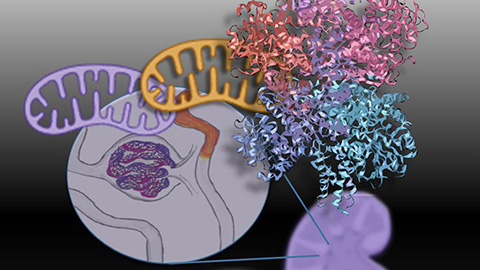
Mitochondria shape kidney cell function
Researchers at the University of Washington, Seattle present the first quantitative comparison of mitochondrial interactomes between two epithelial cell types in the kidney.
Long-chain polyunsaturated fatty acids linked to postoperative delirium risk
Researchers show that altered lipid metabolism may contribute to postoperative delirium, a condition linked to increased risk for long-term cognitive decline. The study explores potential disease mechanisms, which have yet to be understood.
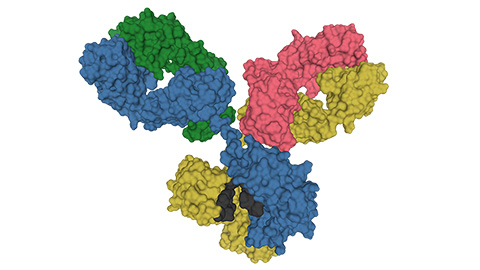
Glycosylation patterns across antibody isotypes distinguish tuberculosis states
Researchers at Taipei Medical University present the first site-specific glycosylation analysis of immunoglobulins in elderly tuberculosis patients.
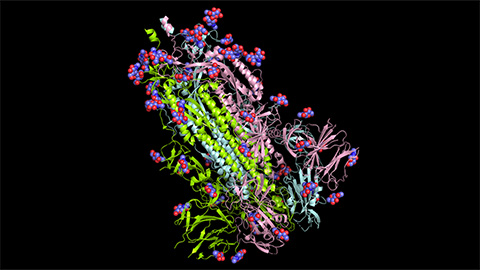
Blood glycome possibly predicts lifespan
Researchers at the University of Santiago de Compostela show that total serum N-glycome can predict mortality independent of traditional risk factors.