
Fueling healthier aging, connecting metabolism stress and time
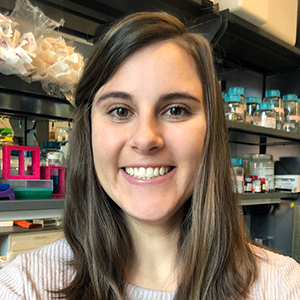
Melanie McReynolds first began asking questions about aging at home, not in the lab. Her parents had her later in life, and she grew up watching them age. Watching her parents grow older sparked her lifelong fascination with how our bodies change over time and what it means to age well.
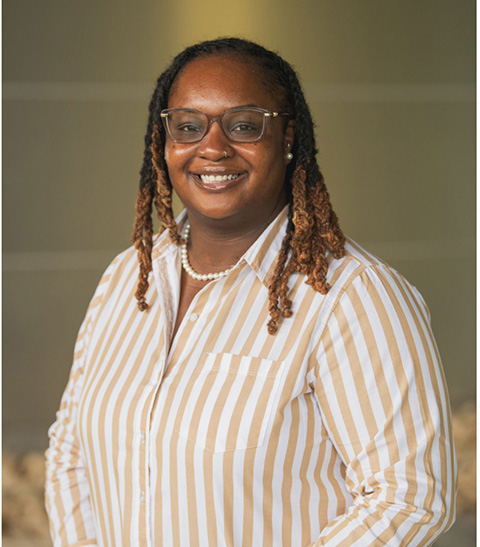
“I was always intrigued by aging and how to age healthier because I saw my parents aging,” she said. “I wanted to understand how to age healthier and avoid age-related diseases.”
Those early observations would fuel her quest to understand the molecular rhythms of aging — and how to make aging healthier.
At Alcorn State University, McReynolds’ curiosity found direction. Selected as one of the school’s top students, she traveled to Bangalore, India, and later attended her first Annual Biomedical Research Conference for Minoritized Scientists.
“I realized there was a career in science,” she said. “I’ve been hooked ever since.”
Connecting metabolism and the aging process
McReynolds first explored the biology of aging in depth during her postdoctoral fellowship at Princeton University, where she began studying how metabolism influences the aging process in the lab of Joshua Rabinowitz. Around the same time, her research took on a deeply personal dimension: her mother was diagnosed with multiple myeloma, a cancer associated with older age.
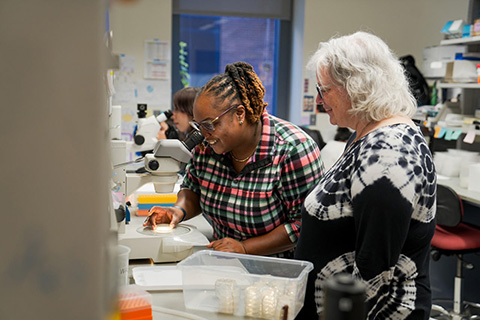
“She was the healthiest senior citizen you ever met,” McReynolds said. “Then after her diagnosis, her decline was rapid — she wasn’t able to do anything.”
Witnessing that transformation changed how McReynolds thought about her work. What had begun as an intellectual curiosity became an urgent mission to understand what happens as we grow older — and how to age healthier.
Aging is the leading risk factor for many of the most common diseases in developed countries, including cancer, diabetes, cardiovascular disease and neurodegenerative disorders. The impact of these conditions is expected to grow as populations live longer; by 2050, the number of Americans over age 65 is projected to increase by more than 40%.
“Older age is a time when we are supposed to retire, travel the world and truly benefit from the fruit of our labor,” McReynolds said. “However, we have to worry about the darker side that comes with aging.”
At Princeton, she began connecting the dots between metabolism and the physiological decline that comes with age. Her work sought to uncover how disruptions in metabolic pathways contribute to age-related diseases and whether manipulating those pathways could promote healthier aging.
The power of NAD+
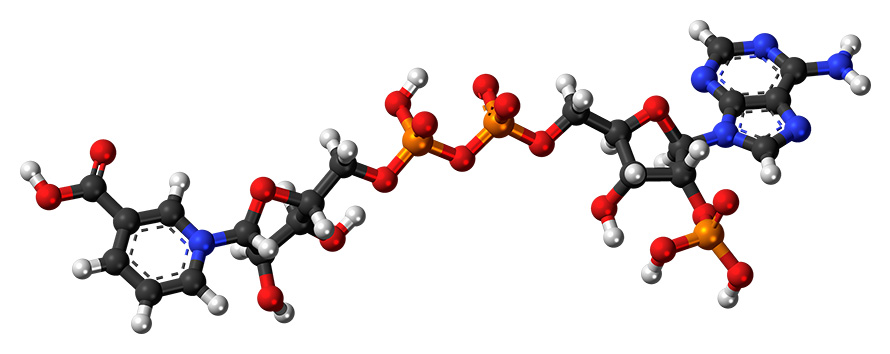
Now an assistant professor of biochemistry and molecular biology at Penn State University, McReynolds’s work focuses on nicotinamide adenine dinucleotide, or NAD+, a molecule central to how cells communicate and convert food into energy.
“Many think of ATP as the main energy currency of the cell, but you need NAD+ to make ATP,” McReynolds said. “NAD+ is the key molecule responsible for breaking down food into energy and is also needed for cells to be able to communicate with each other.”
As we age, levels of NAD+ decline, affecting energy balance and cell repair. McReynolds has long been determined to understand this connection.
As a graduate student at Penn State University, McReynolds studied the synthesis and role of NAD+ in reproductive development. Yet even then, she was already thinking about the link between NAD+ and aging, said Wendy Hanna–Rose, her graduate adviser.
“(McReynolds) went and specifically got the training she needed to work on aging,” Hanna–Rose said. “That’s pretty impressive.”
During her postdoctoral work, Rabinowitz’s lab was developing techniques to trace metabolism in living systems. She initially thought she might have to leave NAD+ behind, but discussions about aging kept resurfacing.
“Every time we talked, it was about aging this and aging that,” McReynolds said.
They knew that no one had examined how NAD+ metabolism shifts in older mice. That question — what happens to NAD+ as we age — would define the next stage of her career.
NAD+ and aging

Supported by a Howard Hughes Medical Institute Hanna Gray Fellowship, McReynolds used techniques including isotope tracing and mass spectrometry to track how fast NAD+ was produced and consumed in young and old mice. Her findings revealed that while NAD+ levels decline with age, production remains largely stable. This suggests that increased consumption drives depletion, and that targeting NAD+-intensive pathways like stress and inflammation may be more effective at combating the consequences of aging than NAD+ supplementation.
Now leading her own lab at Penn State, McReynolds uses the nematode Caenorhabditis elegans to capture metabolism in motion. Her lab combines high-resolution liquid chromatography/mass spectrometry, isotope tracing and multiomics approaches to map how NAD+ and its precursors change as organisms age.
“We're using C. elegans to really understand cellular aging and stress over the lifespan,” McReynolds said.
For this work, she was recently awarded the National Science Foundation Faculty Early Career Development Award, which recognizes early-career faculty who excel in both research and education.
Mapping metabolism across the lifespan
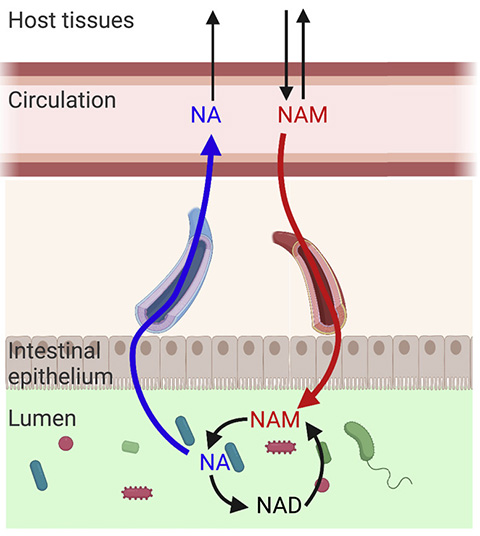
In another line of research, McReynolds explores how energy metabolism intersects with the gut microbiome. In her postdoc, she and collaborators demonstrated that NAD+ precursors move dynamically and bidirectionally between the host and the gut microbiome, revealing the microbiome’s critical role in shaping systemic NAD+ metabolism.
Victoria Baskerville, a graduate student in McReynolds’ lab, is continuing this line of work to understand what happens when the gut microbiome is disrupted by stressors such as inflammation.
“It is essential to know whether age-associated changes in the gut microbiome could contribute to the age-associated decline of NAD+ across tissues,” Baskerville said.
Using multiomics techniques, Baskerville is mapping the NAD+ metabolome across tissues to track metabolism shifts during aging and identify potential sex-based differences. She said that most previous studies on the NAD+ metabolome have primarily relied on male model organisms, leaving sex-specific metabolic and longevity differences largely unaddressed — her research aims to fill this gap.
“Understanding sex-based differences in molecular aging will facilitate the development of tailored interventions that improve healthspan for all,” Baskerville said.
Beyond the bench

McReynolds’ passion for science extends well beyond her lab. Growing up in Mississippi, she had limited exposure to research opportunities, which motivates her commitment to mentorship and outreach.
“Once (McReynolds) came to my lab, there were other students who joined after her specifically because of her,” Hanna–Rose said. “Her advocacy brought other people to my lab.”
Baskerville echoed this sentiment. “I was inspired by the mission of promoting healthier aging,” she said. “But I also joined because Dr. McReynolds is a passionate mentor who cares deeply about developing future scientists.”
As part of her NSF Award, McReynolds is launching Science in Action, an annual outreach series for middle and high school students in her hometown of Louisville, Mississippi.
“My goal is to continue bringing STEM opportunities to middle and high school students in under-resourced areas, while also giving my undergraduate and graduate trainees the chance to lead experiments, serve on panels and mentor the next generation,” she said. “It’s my way of giving back while empowering my students.”
A vision for healthier aging
Looking ahead, McReynolds sees the field of aging research shifting toward strategies that extend healthspan — the years of life spent in good health — rather than lifespan alone.
Her research already has a human impact. NAD+-related supplements have surged in popularity in recent years, often marketed with ambitious promises of extended lifespan. However, McReynolds said the scientific evidence — especially around hyper-supplementation — remains limited, despite the industry’s million-dollar scale.
“It’s fascinating because everyone’s biology is different, and what benefits one person could be detrimental to another,” McReynolds said. “Our goal is to develop safer and more effective ways to support healthy aging, without relying on the one-size-fits-all supplement approaches.”
She also sees a new era of convergence ahead, one that integrates genetics, metabolism, behavior and environment.
“By combining (multiple approaches and disciplines), we can begin to answer some of the biggest questions about what drives aging and age-related disease,” she said.
For McReynolds, pushing the boundaries of aging research also remains personal.
“Seeing my mother and how she transitioned really motivates me to continue this work,” she said. “If we can age healthier, that’s what I think matters and is what still pushes me.”
Enjoy reading ASBMB Today?
Become a member to receive the print edition four times a year and the digital edition monthly.
Learn moreGet the latest from ASBMB Today
Enter your email address, and we’ll send you a weekly email with recent articles, interviews and more.
Latest in Science
Science highlights or most popular articles
Building a better model for drug delivery across the blood–brain barrier
Industry and academic scientists collaborated to develop a rat with humanized iron-transport receptors, enabling research into iron homeostasis and drugs that cross the brain’s barrier.
Fat synthesis enzyme crucial for milk fat and newborn growth
Researchers found that a deficiency of the fatty acid synthesis enzyme stearoyl-CoA desaturase-1 reduced mammary gland function during lactation and caused low birth weight in newborns that were fed milk from enzyme-deficient glands.
Flipping lipids and slime molds
A dull first job nearly pushed JBC associate editor Todd Graham out of science. Then a slime mold project changed his path. Now, he studies membrane biology and reflects on discovery, persistence and mentoring through uncertainty.
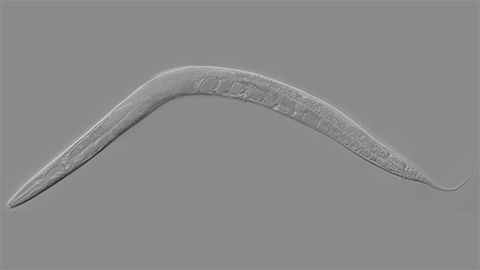
How smelling death alters worm behavior
Researchers have found that the roundworm C. elegans can smell death, and it changes how the worms behave, reproduce and age.
A chance encounter with the lab
Payton Stevens never planned to become a pancreatic cancer researcher. A temporary job set him on a path from rural Kentucky to leading research on Wnt signaling and metastasis, where he now pairs discovery with mentorship and science advocacy.
Light-activated small molecule could transform eye infection treatment
Contact lenses raise the risk of infectious keratitis, a leading cause of blindness worldwide. A biotech company is commercializing a light-activated therapy using a ROS-generating molecule to rapidly kill microbes in the cornea to preserve vision.