
What’s in a diagnosis?
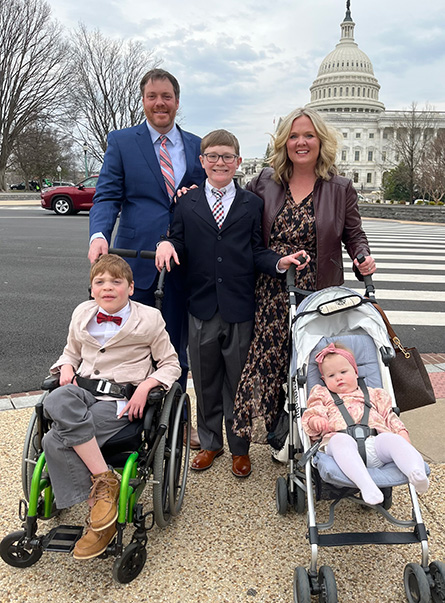
Ben Foglio is a vivacious, playful boy who befriends everyone he meets. But his first years were marked by uncertainty and struggle. His pediatrician called him a “delayed baby,” but his mother Jessica knew something was wrong. After two years many doctors’ visits, specialists eventually diagnosed ben with cerebral palsy, or CP, but Jessica said the label felt incomplete.
Driven by mother's intuition, Jessica pressed for whole exome sequencing despite its cost. A university program made sequencing possible, and at age three Ben finally had an answer: Salla disease.
Salla disease is a rare, autosomal recessive lysosomal storage disorder caused by mutations in the SLC17A5 gene. These mutations cause free sialic acid to build up in cells, impairing brain and motor function. Symptoms include low muscle tone, poor coordination and balance, developmental delays and progressive intellectual disability. There is currently no cure, and treatment focuses on managing symptoms.
Desperate for information, Jessica bought an international phone line to call a Salla disease expert overseas; her call went unanswered.
“In some ways, getting the correct diagnosis made it harder for me,” she said. “Cerebral palsy is much more common than Salla disease, with more resources and knowledge.”
Their experience is common in the rare disease world, where a long “diagnostic odyssey” leaves families searching for answers as the disease advances.
Such delays have lasting consequences, underscoring the need for greater awareness, coordinated care and new tools, like genomic sequencing and artificial intelligence, to speed up diagnoses.
One study of about 3,300 Spanish rare disease participants found that over half faced delays in diagnoses averaging an odyssey of 6.2 years.
“Although I was so thankful to finally know what was happening to Ben's precious body, (I) was very lonely,” Jessica said. “Could I have tried alternative therapies that would have intervened in a more effective way? The devastation, worry, sadness, and loneliness of the disease was a horrible feeling. We were one of eight known (Salla disease) cases at the time of Ben's diagnosis.”
According to U.S. standards, a rare disease affects fewer than 200,000 people nationwide, yet together they impact 6% of the global population, totaling nearly 7,000 conditions.
Programs like the National Institutes of Health Undiagnosed Diseases Program, the U.S.-based Undiagnosed Diseases Network, and the Undiagnosed Diseases Network-International bridge clinical care and research, breaking down geographic and institutional barriers.
Since Ben’s diagnosis, Jessica has made it her mission to ensure that no family feels the same isolation hers once did.
“It was my goal that no family should feel the loneliness that we did,” she said.
Through the STAR Foundation, she has created a robust support network where parents and caregivers can share ideas, resources, and encouragement.
“Parents and caregivers can now actively engage with one another, sharing ideas and knowledge,” Jessica said. “We are working on a standard-of-care document that physicians and providers can follow, guiding families to the best possible outcomes for their child with Salla disease.”
The foundation is also investing in research, funding projects that aim to better understand the biology of Salla disease, identify potential therapeutic targets, and accelerate the path toward clinical trials.
“We are in the early stages of testing drugs (for) Salla disease,” Jessica explained. “If a drug treatment comes to fruition, it would be critical for the patient to have access at a young age, in hopes that it would stop the progression of the disease.”
Enjoy reading ASBMB Today?
Become a member to receive the print edition four times a year and the digital edition monthly.
Learn moreGet the latest from ASBMB Today
Enter your email address, and we’ll send you a weekly email with recent articles, interviews and more.
Latest in Opinions
Opinions highlights or most popular articles
Learning can be fun: Gaming anatomy and physiology
Instructors explore how gamification and active learning transform student engagement and retention. They convey how emotion, interaction and design can make even rigorous subjects more effective and memorable.
Mentorship and uncertainty: Lessons from Telemachus
A biochemistry educator reflects on mentorship through the Greek story of Telemachus, showing how embracing uncertainty, failure and curiosity can transform teaching.
Embracing the twists and turns along the educator pathway
A biochemistry educator reflects on the challenges of early faculty life, describing how evidence-based teaching, cross-disciplinary collaboration and classroom challenges shaped her growth.
Redesigning with students in mind
Assistant professor reflects on how the shift to online teaching revealed gaps in points-based grading and led to a redesign centered on transparency and student growth.
Teaching beyond information transfer
Educator reflects on moving beyond lectures to create a biochemistry classroom centered on engagement, transparency and student ownership, showing how small shifts like “student hours” and active learning can transform understanding.
Mayday! Lessons from cellular dysfunction and group work dynamics
An upper-level biology course revealed that strong science doesn’t guarantee strong teamwork. One instructor shares how failed group dynamics reshaped their approach, leading to more structured, collaborative and effective student learning.