
How pediatric cataracts shaped my scientific journey

Sixteen years ago, my mother and I sat in the cold leather chairs of the optometrist’s office, my legs not yet long enough to touch the floor. Waiting for my new glasses, I began to take apart the plastic eye model sitting on the desk in front of us. It was one of those clunky older things, about the size of a Magic 8 Ball.
I started by removing the thick outer casing holding the cornea and iris, opening the model up to reveal the small crystal disc of the eye lens. It soon sat in my palm, diffracting light and magnifying the wrinkles in my pudgy, toddler-sized hands. With my mother’s encouragement, I spent a lot of time playing with these eye models as a kid. I was enamored.
Before this first trip to the optometrist, my parents noticed my lazy eye when I started kindergarten. A pediatric ophthalmologist diagnosed me with congenital cataracts and recommended a treatment known as intraocular lens, or IOL, implants. Basically, my own eye lenses were replaced with artificial ones — not too dissimilar from the ones in the model. While I don't remember much from this time, my parents vividly recall the anxiety and the stress of such a costly surgery.
Fast-forward to the end of high school, and I had my sights set on one thing: undergraduate research. It was the biggest factor in my college selection process — the light at the end of my Common App — the idea of a life in a lab.
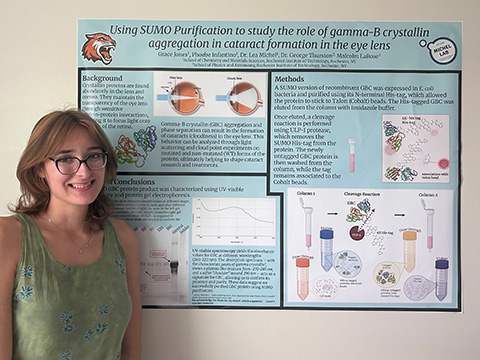
I arrived on campus with this goal in mind and was Googling research labs before I unpacked my socks. You can imagine my surprise when I came across a biochemistry lab studying the protein interactions that cause cataracts. I was convinced it was kismet.
The idea that my passion for science could be used to study a condition that shaped my childhood was invaluable to me, and it drove me to swallow my nerves and reach out to the professor. I interviewed the following week and started research soon after.
What began as curiosity about an eye model soon turned into hands-on exploration of the very molecules that shape vision. Crystallins are the proteins that make up most of the eye lens. Mutations and posttranslational modifications can alter their interactions, resulting in clouding of the lens, also known as cataracts.
I don't often think about my surgery or my cataracts, but every now and then, when I’m doing research and my sample crashes out into a precipitate, I take a step back. The cataractogenesis my sample undergoes in the lab is a mild annoyance — it means I must restart the protein purification process — but in a person’s eye, it can be life-altering and costly. IOL implants are expensive, and the surgery to replace a cloudy lens carries risks, especially in toddlers and young children.
I’m very grateful for my health, the experience and skill of my surgical team, and the resources that my family had so that I could undergo treatment. But, perhaps I’m most grateful for the opportunity to advance our understanding of cataracts through my own research — a challenge I can undertake because of the surgery I had 16 years ago.
My medical history is a testament to the purpose of my biochemical research and a reminder of why science matters: to improve health and livelihoods for all, sometimes including the researchers themselves. My personal experience has fueled my scientific purpose, driving me to cherish my research as a tool for the betterment of humanity.
Enjoy reading ASBMB Today?
Become a member to receive the print edition four times a year and the digital edition monthly.
Learn moreGet the latest from ASBMB Today
Enter your email address, and we’ll send you a weekly email with recent articles, interviews and more.
Latest in Opinions
Opinions highlights or most popular articles
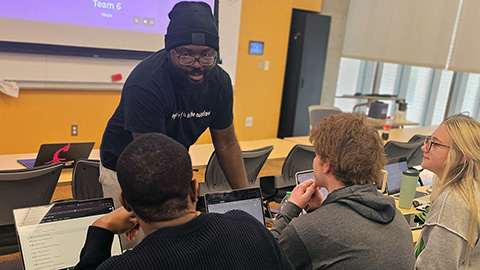
Learning can be fun: Gaming anatomy and physiology
Instructors explore how gamification and active learning transform student engagement and retention. They convey how emotion, interaction and design can make even rigorous subjects more effective and memorable.
Mentorship and uncertainty: Lessons from Telemachus
A biochemistry educator reflects on mentorship through the Greek story of Telemachus, showing how embracing uncertainty, failure and curiosity can transform teaching.
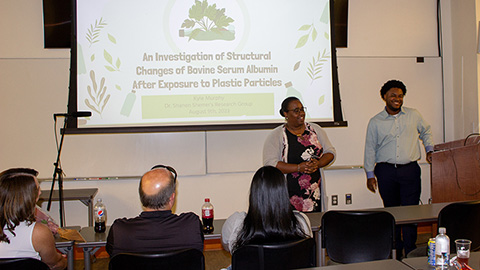
Embracing the twists and turns along the educator pathway
A biochemistry educator reflects on the challenges of early faculty life, describing how evidence-based teaching, cross-disciplinary collaboration and classroom challenges shaped her growth.
Redesigning with students in mind
Assistant professor reflects on how the shift to online teaching revealed gaps in points-based grading and led to a redesign centered on transparency and student growth.
Teaching beyond information transfer
Educator reflects on moving beyond lectures to create a biochemistry classroom centered on engagement, transparency and student ownership, showing how small shifts like “student hours” and active learning can transform understanding.
Mayday! Lessons from cellular dysfunction and group work dynamics
An upper-level biology course revealed that strong science doesn’t guarantee strong teamwork. One instructor shares how failed group dynamics reshaped their approach, leading to more structured, collaborative and effective student learning.