
JLR: What controls cholesterol biosynthesis?

Homeostasis is an important biochemical principle. The pace of a biosynthetic pathway often is controlled by feedback from pathway products, adjusting the system to prevent excessive accumulation of its products.
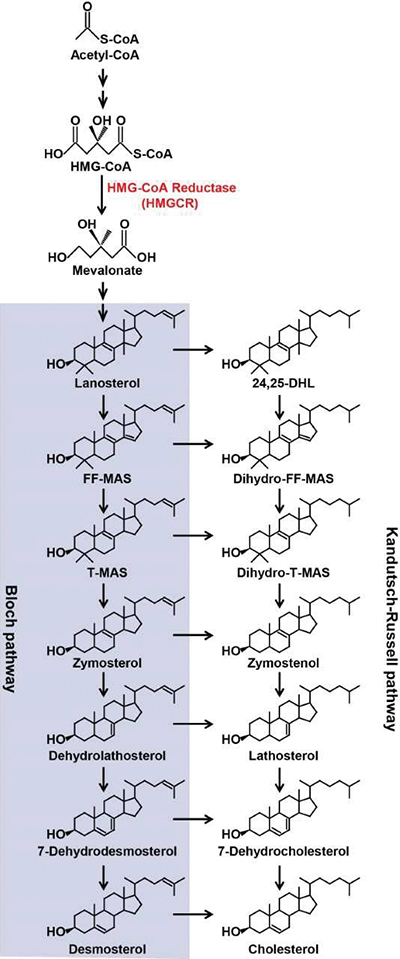 A pathway diagram shows two parallel routes from mevalonate to cholesterol.Bao-Liang Song
Cholesterol biosynthesis is one example. Researchers know it is regulated by metabolic intermediates but until now have disagreed about which intermediates do the work. In the Journal of Lipid Research, Liang Chen and colleagues at Wuhan University and the Chinese Academy of Sciences report that several metabolites can affect the activity of two cholesterol biosynthesis enzymes. The study gives new insight into how cholesterol biosynthesis is regulated.
Researchers knew that an intermediate product of the biosynthetic pathway could inhibit each of two control points: HMG-CoA reductase, or HMGCR, which synthesizes a key cholesterol precursor called mevalonate, and sterol responsive element-binding protein, or SREBP, a transcription factor that affects many cholesterol synthesis enzymes.
Data suggested that lanosterol, the first intermediate in the pathway that is cyclic instead of linear, was the key regulator, but the researchers knew that a slightly modified version of lanosterol might be more important. The question is complicated because the cholesterol biosynthesis pathway bifurcates after lanosterol is formed.
In lanosterol or any of its downstream products, a double bond in the molecule’s alkyl tail can be reduced, and the reduced molecules proceed through the same steps to be turned into cholesterol (see figure). So which intermediate cholesterol metabolite exerts the most control over the overall biosynthetic pathway?
That is a technically difficult problem. It is hard to induce accumulation of specific intermediates, because no effective enzyme inhibitors exist for specific steps in sterol synthesis and cells are unlikely to take up exogenously added pathway intermediates.
Chen and colleagues worked around these difficulties by generating a cell line better equipped to absorb mevalonate, a key intermediate produced by HMGCR. In these cells, intermediates can accumulate even if HMGCR activity is blocked. When these cells are provided with mevalonate, they scale up cholesterol production, triggering homeostatic degradation of HMGCR and blocks SREBP activation.
The team then systematically knocked out cholesterol biosynthesis enzymes using CRISPR, forcing traffic to back up immediately upstream of whichever conversion step had been blocked. Using lipidomic analysis of sterol extracts from each knockout cell line, they assessed the impact of loss of each enzyme and accumulation of its substrate, identifying key metabolites that impacted levels of HMGCR and SREBP.
The researchers showed that lanosterol down-regulated HMGCR but not SREBP, confirming that lanosterol and not its reduced relative is the key regulator. They also found that other sterol intermediates with reduced double bonds inhibited both HMGCR and SREBP. The authors say that molecules resembling these endogenous regulators could be a new way to control cholesterol levels.
Enjoy reading ASBMB Today?
Become a member to receive the print edition four times a year and the digital edition monthly.
Learn moreGet the latest from ASBMB Today
Enter your email address, and we’ll send you a weekly email with recent articles, interviews and more.
Latest in Science
Science highlights or most popular articles
Mitochondria shape kidney cell function
Researchers at the University of Washington, Seattle present the first quantitative comparison of mitochondrial interactomes between two epithelial cell types in the kidney.
Long-chain polyunsaturated fatty acids linked to postoperative delirium risk
Researchers show that altered lipid metabolism may contribute to postoperative delirium, a condition linked to increased risk for long-term cognitive decline. The study explores potential disease mechanisms, which have yet to be understood.
Glycosylation patterns across antibody isotypes distinguish tuberculosis states
Researchers at Taipei Medical University present the first site-specific glycosylation analysis of immunoglobulins in elderly tuberculosis patients.
Blood glycome possibly predicts lifespan
Researchers at the University of Santiago de Compostela show that total serum N-glycome can predict mortality independent of traditional risk factors.
Building a better model for drug delivery across the blood–brain barrier
Industry and academic scientists collaborated to develop a rat with humanized iron-transport receptors, enabling research into iron homeostasis and drugs that cross the brain’s barrier.
Fat synthesis enzyme crucial for milk fat and newborn growth
Researchers found that a deficiency of the fatty acid synthesis enzyme stearoyl-CoA desaturase-1 reduced mammary gland function during lactation and caused low birth weight in newborns that were fed milk from enzyme-deficient glands.