
Searching for drugs on the ocean floor
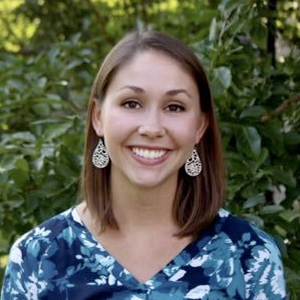
San Diego is a great location for the ASBMB annual meeting because, as Ana Maria Barral points out here, it is home to so many life scientists. This is the story of how one researcher made his way to “the town at the tip of California.”
 Paul Jensen and graduate student Nastassia Patin collect sediment samples in 2014 at the Smithsonian field station in Carrie Bow Cay, Belize.Greg RouseGrowing up in New York City, Paul Jensen watched the famous undersea explorer Jacques Cousteau on television and dreamed of studying the ocean.
“I wanted to explore the water even though I couldn’t get in it very often,” Jensen said.
No one in Jensen’s family ever had graduated from college, but he was determined to learn more about science and the sea. He took a leap of faith after high school and some community college, moving south to pursue a bachelor’s degree in marine biology at the Florida Institute of Technology.
Now, decades later, the first-generation college student and East Coast city kid is a professor at Scripps Institution of Oceanography in San Diego. Jensen’s nontraditional career path equipped him with tools to mentor future scientists and to study marine microbes for drug discovery.
He initially thought earning an undergraduate degree was all that mattered, and he received little guidance about what would come next.
“I didn’t understand what was needed to advance in a career in science,” he said.
Getting hooked
After graduation, he found a job at Harbor Branch, an oceanographic research institute in Florida. Around that time, Harbor Branch started Seapharm, one of the first programs to search the ocean for potential drugs produced by microbes as biologically active secondary metabolites. It was Jensen’s first exposure to the field of natural products, and he was hooked. The institute was small, so he was able to lead projects and publish first-author papers.
When an outside company withdrew funding for Seapharm, Jensen faced a choice. He could take another position within Harbor Branch or move to San Diego to work as a technician at Scripps under the organic chemist William Fenical.
Jensen elected to take the position at Scripps and used his Harbor Branch experience to help Fenical establish a program in marine microbial natural products. In 2003, Jensen, Fenical and others discovered salinosporamide A, a small molecule produced by the marine microbe Salinispora tropica. After years of work by many scientists, the biopharmaceutical company Celgene now is developing the discovery for cancer treatment.
Jensen enjoyed making discoveries with Fenical, but he quickly realized a graduate degree was key to advancing professionally in marine science.
“If you have ambitions about exploring your own ideas and doing creative science, then you have to go to graduate school,” he said.
Jensen earned a master’s from San Diego State University and returned to Scripps to complete his doctorate in marine biology. He worked at Scripps for 13 years as a non-tenure track faculty member before becoming a professor.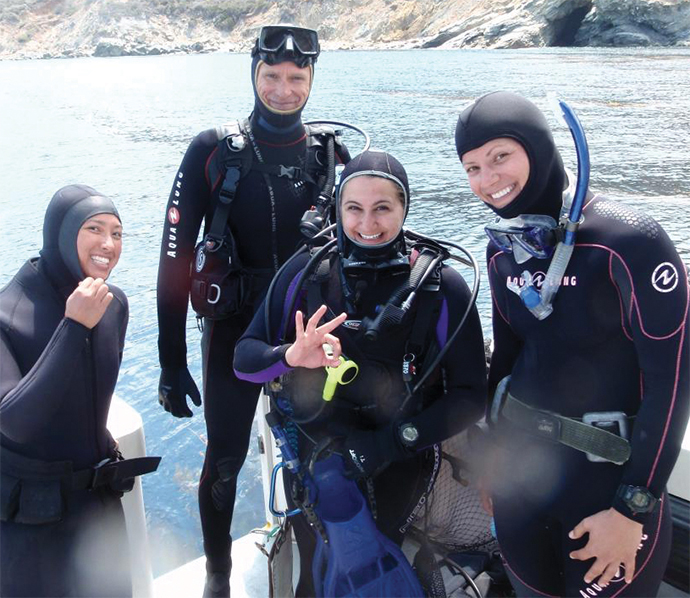 Paul Jensen, center, and members of his lab collect samples at the Channel Islands.Courtesy of paul jensen
Marathon training
After many years doing research at Scripps, Jensen said the part of the work he most values is the students.
“We get many of the brightest and most enthusiastic minds from around the world that want to come here for graduate studies,” he said. “Their energy, dedication and effort lead to discoveries that put our institution at the forefront of so many areas of marine science.”
Graduate school is about learning how to think independently and solve problems, he said, and the students who do the best at Scripps are the ones who embrace this independence. Jensen encourages the students in his lab to decide the direction of their thesis research and offers them wisdom from his own career path.
“I tell my students it’s a marathon, not a sprint,” he said. “If you’re doing research you really like, then there’s value in staying in it even if it takes some time for your career path to develop.”
His students’ research today looks very different from the work Jensen did when he started at Scripps. Advances in molecular genetics have transformed the way scientists study natural product synthesis.
Random isolation and culturing of marine microbes has been streamlined with high-throughput DNA sequencing to identify strains of bacteria with new or interesting gene patterns. This method, known as genome mining, helps Jensen and other scientists understand what genes look like and how they make enzymes to build natural products.
Jensen does less hands-on work now than when he first came to Scripps, but he still loves getting in the water for field work. About twice a year, he and members of his lab visit marine labs in places such as California’s Channel Islands, Fiji, Belize and the island of Moorea in French Polynesia to collect samples for research.
“Two weeks in the field can generate two years’ worth of work in the lab,” he said.
Buried resins
Back on shore, Jensen’s lab screens samples from various habitats to identify genes that appear relevant for making natural products. With advances in sequencing, they can examine ocean environments at a DNA level and predict where interesting natural products are synthesized.
His lab also uses absorbent resins to study natural product synthesis at its source.
“We are looking to see if we can detect molecules directly in the habitats in which they are produced,” he said.
The resins are buried in ocean sediments to capture molecules made by microbes in the environment. In the lab, the molecules are removed from the resin with an organic solvent and analyzed to learn about how and why they are made. Jensen believes these techniques will lead to findings about marine microbe interactions with hosts and chemical competition among bacteria.
Changes in the field have broadened the scope of Jensen’s research. With access to DNA sequence data, his researchers can study the evolution of natural products in marine microbes. Jensen’s lab looks at closely related microbial species to see how they make different versions of similar molecules. Their analysis gives his team a chance to see how nature works to generate chemical diversity.
“We could identify the microbes before,” Jensen said, “but we could never understand the relationships between the microbes and the molecules they produced.”
Jensen’s work has evolved with time to harness the wealth of microbes produced beneath the ocean’s surface. His career path, though unclear early on, taught him the importance of running the slow and steady race for science. Today, he continues to use what he learned along the way to make breakthroughs in marine microbiology.
Enjoy reading ASBMB Today?
Become a member to receive the print edition four times a year and the digital edition monthly.
Learn moreGet the latest from ASBMB Today
Enter your email address, and we’ll send you a weekly email with recent articles, interviews and more.
Latest in Science
Science highlights or most popular articles
Mitochondria shape kidney cell function
Researchers at the University of Washington, Seattle present the first quantitative comparison of mitochondrial interactomes between two epithelial cell types in the kidney.
Long-chain polyunsaturated fatty acids linked to postoperative delirium risk
Researchers show that altered lipid metabolism may contribute to postoperative delirium, a condition linked to increased risk for long-term cognitive decline. The study explores potential disease mechanisms, which have yet to be understood.
Glycosylation patterns across antibody isotypes distinguish tuberculosis states
Researchers at Taipei Medical University present the first site-specific glycosylation analysis of immunoglobulins in elderly tuberculosis patients.
Blood glycome possibly predicts lifespan
Researchers at the University of Santiago de Compostela show that total serum N-glycome can predict mortality independent of traditional risk factors.
Building a better model for drug delivery across the blood–brain barrier
Industry and academic scientists collaborated to develop a rat with humanized iron-transport receptors, enabling research into iron homeostasis and drugs that cross the brain’s barrier.
Fat synthesis enzyme crucial for milk fat and newborn growth
Researchers found that a deficiency of the fatty acid synthesis enzyme stearoyl-CoA desaturase-1 reduced mammary gland function during lactation and caused low birth weight in newborns that were fed milk from enzyme-deficient glands.