
Aebersold receives
Sober Lectureship
Ruedi Aebersold, a pioneer in proteomics and systems biology, has been named the recipient of the 2010 American Society for Biochemistry and Molecular Biology Herbert A. Sober Lectureship, recognizing outstanding biochemical and molecular biological research with particular emphasis on the development of methods and techniques to aid in research.
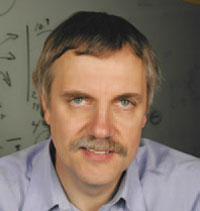
As part of his award, Aebersold, a professor at the Institute for Molecular Systems Biology at the Swiss Federal Institute of Technology Zürich with a joint appointment at the University of Zürich, will present an award lecture titled “Mapping and Measuring Molecular Networks in Cells” at 8:30 a.m. Sunday, April 25, at the 2010 annual meeting in Anaheim, Calif.
For the past 30 years, Aebersold, who received his doctoral degree in cell biology from the University of Basel in 1984, has been developing tools and techniques that have been invaluable in the fields of analytical protein chemistry, systems biology and proteomics, a technique that allows researchers to compare the proteomes of two different cell populations, for example cells grown in different media.
His group’s efforts have led to the emergence of both gel-free protein identification and quantitative mass spectrometry, perhaps best exemplified by his development of isotope-coded affinity tag proteomics. In addition, Aebersold has created a host of computational tools to assist researchers in analyzing mass spectrometry-derived proteomics data, such as the Trans-Proteomic Pipeline, a program that estimates the percentage error in a dataset.
As Fuchu He, president and director of the Beijing Proteome Research Center, succinctly put it, “The series of his contributions has fueled the proteomic revolution. The methods he developed are now used in thousands of laboratories around the world and are contributing to an explosion of new biological and clinical knowledge.”
Aebersold’s impressive career has spanned two continents. After his Ph.D. studies in Basel, he worked as a postdoctoral fellow and senior research fellow at the California Institute of Technology, had professorships at the University of British Columbia and the University of Washington and co-founded the Institute for Systems Biology in Seattle (with Lee Hood and Alan Aderem) in 2000 before returning to Switzerland in 2004.
In addition to building technologies for other researchers to use, Aebersold and his team have been employing ICAT and other proteomic approaches in their own comparative studies of protein expression in cells under different conditions. Some specific areas of study include large-scale analyses of post-translational protein modifications, an examination of abnormal protein expression in cancerous cells and systematic studies of how cells respond to external stimuli.
These comparative protein profiles will lead to a more robust understanding of the biochemical processes that regulate cell physiology and also could lead to new prognostic and/or diagnostic biomarkers for disease.
Aebersold, who is also an associate editor for Molecular and Cellular Proteomics, has received numerous awards for his work, including the American Society for Mass Spectrometry Biemann Medal, the Pehr Edman Award, the Michael Widmer Award, the World Technology Network Award for Biotechnology, the Genome Technology Award in Proteomics and the Human Proteome Organization achievement award.
“He has inspired a whole generation of young scientists at the University of Washington, the Institute for Systems Biology and the ETH-Zurich, as well as indirectly through his publications and his active engagement in many leading professional organizations,” said Gilbert S. Omenn, professor of internal medicine, human genetics and public health at the University of Michigan Medical School and vice president of HUPO.
Enjoy reading ASBMB Today?
Become a member to receive the print edition four times a year and the digital edition monthly.
Learn moreGet the latest from ASBMB Today
Enter your email address, and we’ll send you a weekly email with recent articles, interviews and more.
Latest in People
People highlights or most popular articles
Uncovering the molecular roots of fatty liver disease
Physician–scientist Silvia Sookoian discusses her path from hepatitis C care to MASLD research, her use of multi-omics to study steatotic liver disease, and how lipid metabolism and genetics are reshaping understanding of MASH and liver health.
Kimble honored for lifetime achievement in genetics
She received the 2026 Thomas Hunt Morgan Medal and will be honored with a dedicated online profile and seminar.
Janetka named distinguished professor
Washington University awarded him the inaugural Carl Frieden Distinguished Professorship.
ASBMB members receive ASPET awards
The American Society for Pharmacology and Experimental Therapeutics awards Simone Brixius–Anderko, Paul Insel, Sudarshan Rajagopal, Emily Scott, Alan Smrcka and Jürgen Wess for their excellent research and mentoring work in pharmacology.
Kozul honored by Washington University
She received the 2025 Elliot L. Elson Education and Training Award.
de la Fuente honored for AI research
The award will support the development of an AI system called ApexMol, a 3D structure–informed, agentic large language model designed to create new biomolecules.