
Redefining excellence to drive equity and innovation

As an undergraduate, Donita Brady had limited access to hands-on research and little sense of where a chemistry degree might take her. As she advanced in research, she sometimes struggled with a lack of representation and shared identity in science. Now, Brady helps expand access for scholars from underrepresented backgrounds. For her work expanding access to science, Brady has been named the recipient of the 2026 ASBMB Ruth Kirschstein Maximizing Access in Science Award.
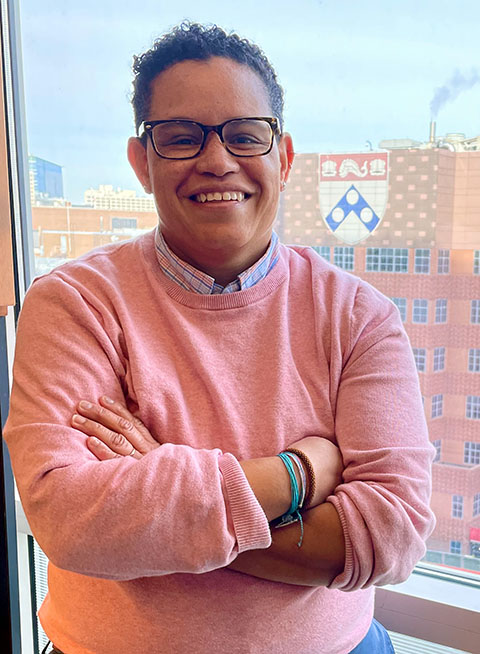
At the University of Pennsylvania, Brady said she takes pride in the school’s pathway programs she helped develop. These initiatives expose students to research early and provide an opportunity for advanced consideration into Penn’s biomedical Ph.D. programs.
She also emphasizes Penn’s holistic reviews for applicants to its summer, postdoctoral and Ph.D. programs. To redefine recruitment, Brady developed and implemented a rubric-based review system, an evidence-driven approach to selection. The rubric has made Penn’s recruiting practices more equitable and has been key in sustaining strong matriculation rates among underrepresented scholars.
“We are redefining the future of diversity, equity, and inclusion through the lens of excellence,” Brady said. “To realize this vision, we must reconsider how we define excellence itself and pursue it in ways that advance the frontiers of research and medicine.”
For the past decade, Brady has led the Office of Research Trainee Affairs, serving as both assistant dean for research training and faculty director. She also serves as associate director of professional opportunities and engagement at the Abramson Cancer Center and vice chair for strategic access and community enrichment in the department of cancer biology. She has mentored countless scholars and consistently fosters a culture grounded in equity, empowerment and belonging.
Now a presidential associate professor of cancer biology, Brady’s research focuses on the role of metal micronutrients in cancer cell growth. Her innovative work positions her as a scientific leader, but what sets her apart is her dedication to dismantling systemic barriers that limit participation in research careers.
In their nomination letter, Penn colleagues George M. Burslem and Kristen W. Lynch wrote, “Dr. Brady is a trailblazing scientist and an extraordinary advocate for inclusion and equity whose contributions have transformed the scientific landscape — not only through her groundbreaking research into the roles of copper signaling in cancer biology, but also through her deeply rooted and sustained commitment to mentoring and empowering historically excluded groups in science.”
Brady served as co-chair of the 2025 ASBMB Annual Meeting and will speak at the 2026 Annual Meeting. She will discuss programs and strategies that reimagine admissions, mentoring and recruitment to strengthen the scientific training pipeline and build resilient pathways for future scientists.
“By fostering persistence and redefining excellence, we can build a research ecosystem that drives both equity and innovation,” she said. “And we need to continue to define excellence such that it's broad enough to capture anyone who finds themselves without equal opportunity to achieve their dreams.”
Enjoy reading ASBMB Today?
Become a member to receive the print edition four times a year and the digital edition monthly.
Learn moreFeatured jobs
from the ASBMB career center
Get the latest from ASBMB Today
Enter your email address, and we’ll send you a weekly email with recent articles, interviews and more.
Latest in People
People highlights or most popular articles
ASBMB members receive ASPET awards
The American Society for Pharmacology and Experimental Therapeutics awards Simone Brixius–Anderko, Paul Insel, Sudarshan Rajagopal, Emily Scott, Alan Smrcka and Jürgen Wess for their excellent research and mentoring work in pharmacology.
Kozul honored by Washington University
She received the 2025 Elliot L. Elson Education and Training Award.
de la Fuente honored for AI research
The award will support the development of an AI system called ApexMol, a 3D structure–informed, agentic large language model designed to create new biomolecules.
In memoriam: Peter Roepstorff
He was a leading researcher in biological mass spectrometry, mapped protein function in living organisms and was an ASBMB member for 19 years.
Flipping lipids and slime molds
A dull first job nearly pushed JBC associate editor Todd Graham out of science. Then a slime mold project changed his path. Now, he studies membrane biology and reflects on discovery, persistence and mentoring through uncertainty.
ASBMB members receive RNA Society awards
The RNA Society awards Brenda Bass, Can Cenik and Karin Musier–Forsyth for their achievements in RNA research and innovation. Winners will be recognized at the closing awards ceremony of the RNA 2026 annual meeting.