
We are here because we choose to be
It’s been more than a month since Vice President Mike Pence penned a Wall Street Journal op-ed claiming the administration’s victory over the coronavirus — and highlighting President Donald Trump’s leadership and compassion. At the time, I wrote that such a spiking-of-the-football piece was foolish. Where are we now?
On the day Pence’s piece was published, the U.S. reported 23,366 new cases. Today, it is more than 63,000. Testing capacity continues to grow, as do positivity rates, with dozens of states reporting increasing weekly percent positive rates.
The Trump administration has alternated between attacking the scientists and federal agencies that would normally be leading the nation out of this public health crisis and praising them. The attacks have eroded the public’s trust in experts and irresponsibly politicized a public health crisis.
Trump’s top trade adviser, Peter Navarro, brazenly attacked Anthony Fauci, director of the National Institute of Allergy and Infectious Diseases, as being “wrong about everything” regarding the COVID-19 pandemic in a USA Today piece. But now, the White House is trying to walk back their attacks on Fauci.
Our children have become the latest political pawns, as the federal government aggressively pushes for in-person instruction at schools this fall but without offering sufficient guidance or funding to do so. The White House has even called school-reopening guidelines released by the Centers for Diseases Control and Prevention overly restrictive.
COVID-19 continues to spiral out of control as state leaders grapple with a disjointed response from the federal government and silence from Congress. The first U.S. governor has tested positive for the virus, while the governor of Georgia has inexplicably banned localities from issuing mask mandates. That decision came on the same day the CDC director said in an interview that the U.S. can knock this virus down if we all just wear masks. And the Maryland governor has written about how the president has left all the states to fend for themselves.
Unemployment continues to soar. Americans need intensive, expensive medical treatment, which they can barely afford as they lose health insurance benefits in large numbers. The economy has stalled again, and Congress has been reluctant to extend unemployment benefits enacted early in the pandemic. Americans are dying, and there is no end in sight.
Scientists, public health officials, doctors and advocates like me have for months been saying that leaders must look to the experts and heed their advice. Thoughtful, reasoned, fact-supported cases have been made for how we can rein in this pandemic. Countless news outlets have interviewed doctors, virologists, epidemiologists and former heads of federal agencies about how to slow the spread. Masks, hand hygiene and physical distancing are simple, inexpensive and effective steps we can take to save lives.
But public trust in our institutions, in our scientific leaders and in our federal agencies is so low. While scientific literacy has increased throughout the U.S. because of the pandemic, it’s not something that comes naturally to many Americans. Expecting them to suddenly understand everything about the SARS-Cov-2 virus is a big ask.
Many of our leaders have politicized the common-sense steps necessary to overcome this pandemic so deeply that we now must take our health and well-being into our own hands. We must stop taking medical advice from the reality show president and his merry band of misfits. Why do we care what a real estate mogul or a trade and manufacturing adviser think about medical treatments that have proved to be ineffective in combatting this virus? And why do we follow the advice of local politicians who refuse to acknowledge the crisis at their front doors?
The responsibility to overcome the pandemic — to reopen the economy and schools — rests in our hands. We private citizens can do the right thing, regardless of what our political leaders tell us, regardless of the partisan talking points being shared or the social media memes being spread. We can choose to listen to experts and do the simple things, whether or not our president, governor or relatives agree. And we can choose to stop waiting for feckless leaders to help.
When you go to the doctor because you’re sick, you take the medicine they prescribe because they know what they are doing. You don’t run the doctor's advice by your city councilman, senator or advisers to the president. We know what we have to do. We know how to fix this.
It is July 2020, and our leaders have abdicated their responsibility. It’s up to us now — and if the country continues to sink deeper into crisis, we will have no one to blame but ourselves.
Enjoy reading ASBMB Today?
Become a member to receive the print edition four times a year and the digital edition monthly.
Learn moreGet the latest from ASBMB Today
Enter your email address, and we’ll send you a weekly email with recent articles, interviews and more.
Latest in Opinions
Opinions highlights or most popular articles
Learning can be fun: Gaming anatomy and physiology
Instructors explore how gamification and active learning transform student engagement and retention. They convey how emotion, interaction and design can make even rigorous subjects more effective and memorable.
Mentorship and uncertainty: Lessons from Telemachus
A biochemistry educator reflects on mentorship through the Greek story of Telemachus, showing how embracing uncertainty, failure and curiosity can transform teaching.
Embracing the twists and turns along the educator pathway
A biochemistry educator reflects on the challenges of early faculty life, describing how evidence-based teaching, cross-disciplinary collaboration and classroom challenges shaped her growth.
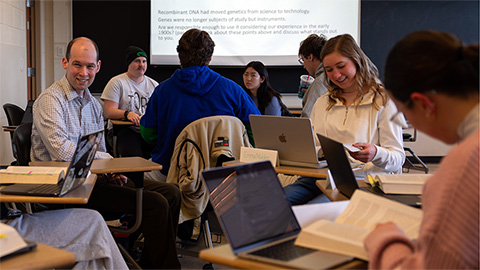
Redesigning with students in mind
Assistant professor reflects on how the shift to online teaching revealed gaps in points-based grading and led to a redesign centered on transparency and student growth.
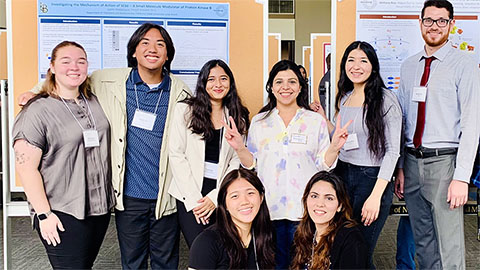
Teaching beyond information transfer
Educator reflects on moving beyond lectures to create a biochemistry classroom centered on engagement, transparency and student ownership, showing how small shifts like “student hours” and active learning can transform understanding.
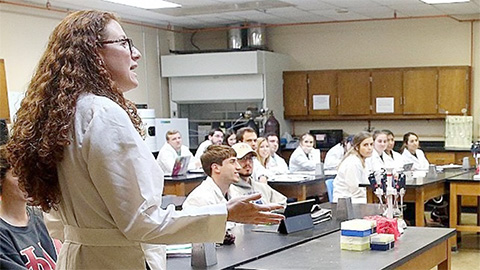
Mayday! Lessons from cellular dysfunction and group work dynamics
An upper-level biology course revealed that strong science doesn’t guarantee strong teamwork. One instructor shares how failed group dynamics reshaped their approach, leading to more structured, collaborative and effective student learning.