

Shades of cultural difference
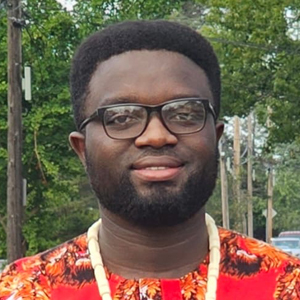
“Welcome to America.” This phrase filtered into my mind as our flight touched down at John F. Kennedy International Airport, New York. And then I thought, “I am in the United States of America.”
I was in the U.S. for my Ph.D. studies on a full-ride scholarship with a teaching assistant position at the University at Albany, State University of New York. I was excited and filled with a deep sense of gratitude.
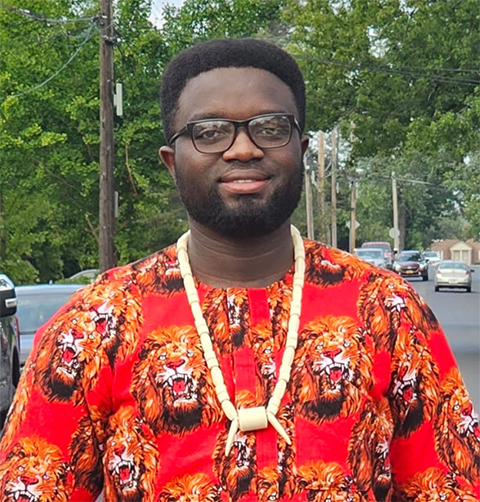
My initial joy soon gave way to mixed feelings. I was perplexed by the cultural norms here; my greetings frequently went unacknowledged. In Nigeria, people are always willing to accept and return greetings, especially from a foreigner.
“Can’t they hear me?” I wondered, and, because this was during the COVID-19 pandemic, I asked myself, “Is my mask deadening my voice?”
Emmanuel, a Ghanian student I got linked up with through the UAlbany biology department’s Buddy Program, provided reassurance. “Humphrey, this is the U.S., not Nigeria,” he reminded me with a smile. “Not returning a greeting here doesn’t necessarily mean you weren’t heard. They must have responded by smiling, but you can’t see it because of the mask.”
For some weeks, Emma was my go-to whenever I needed something — until I was able to get a bank account and replace my incompatible Xiaomi phone.
Other aspects of American culture were completely foreign to me. We called our professors by their first names; in Nigeria, we mandatorily use title and last name. My principal investigator got me some welcome packages and drove me to get my COVID test. Later, I took a short trip to Chicago to visit some friends and family where I briefly reconnected and enjoyed some Nigerian meals.
When I began attending classes via Zoom, I was eager to see new faces, even though I had trouble recognizing these faces when we weren’t on Zoom because everyone was wearing masks. The first time I was able to identify a fellow in my cohort, I walked up to him and said, “Hi, you’re Rick, right? I am Humphrey.”
I wasn’t prepared for him to run up the next flight of steps and dart away after returning my greeting. I later learned that this was his modus operandiand not a personal slight.
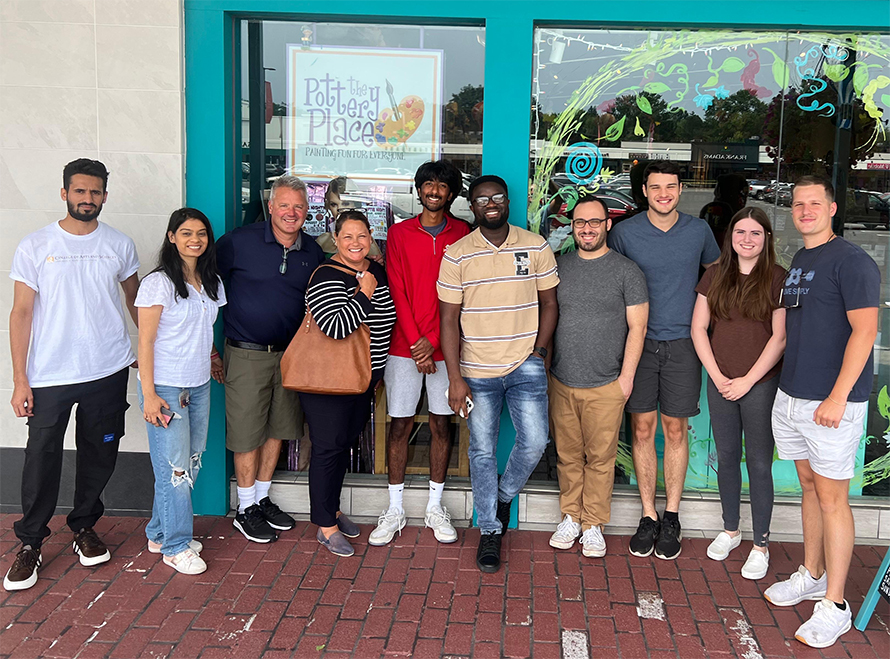
Scholastically, things were awesome. I joined a lab and was surrounded by a great team. I was glad this was going to be my home for at least the next four years. We are from diverse backgrounds — Nigeria, India, Germany, Iran and the U.S. We celebrate each other’s birthday and embrace our rich diversity, from organizing lab potlucks, where we all bring our dishes from our native countries, to deciding on lunch restaurants that will appeal to everyone’s taste — we always joke about how Indians and Nigerians love spicy meals.
I learned to address my PI by his nickname. “Hi, Tom” I’d greet him each time we saw each other, and with a smile, he’d respond, “Hi, Humphrey.”
At first, I was uncomfortable with this, but with time, I became accustomed — mainly because he creates an environment of comfort and makes sure we are in our best states of mind and health. His motto is “work hard, play hard, and don’t forget to eat.”
The U.S. is not just my academic destination anymore; it’s where I learned to navigate and appreciate shades of cultural differences, translating my early culture shock into a journey of discovery and connection.
Enjoy reading ASBMB Today?
Become a member to receive the print edition four times a year and the digital edition monthly.
Learn moreGet the latest from ASBMB Today
Enter your email address, and we’ll send you a weekly email with recent articles, interviews and more.
Latest in Opinions
Opinions highlights or most popular articles
Learning can be fun: Gaming anatomy and physiology
Instructors explore how gamification and active learning transform student engagement and retention. They convey how emotion, interaction and design can make even rigorous subjects more effective and memorable.

Mentorship and uncertainty: Lessons from Telemachus
A biochemistry educator reflects on mentorship through the Greek story of Telemachus, showing how embracing uncertainty, failure and curiosity can transform teaching.
Embracing the twists and turns along the educator pathway
A biochemistry educator reflects on the challenges of early faculty life, describing how evidence-based teaching, cross-disciplinary collaboration and classroom challenges shaped her growth.
Redesigning with students in mind
Assistant professor reflects on how the shift to online teaching revealed gaps in points-based grading and led to a redesign centered on transparency and student growth.
Teaching beyond information transfer
Educator reflects on moving beyond lectures to create a biochemistry classroom centered on engagement, transparency and student ownership, showing how small shifts like “student hours” and active learning can transform understanding.
Mayday! Lessons from cellular dysfunction and group work dynamics
An upper-level biology course revealed that strong science doesn’t guarantee strong teamwork. One instructor shares how failed group dynamics reshaped their approach, leading to more structured, collaborative and effective student learning.