
And they’re off: Budget season begins in Congress

With the release of the president’s budget request, the congressional appropriations process is officially off to the races, and ASBMB’s Public Affairs Advisory Committee is guiding the society’s strong advocacy response.
In early April, President Trump sent his budget request to Congress. The budget proposed significant cuts to federally funded science agencies, including the National Institutes of Health, the National Science Foundation and the Department of Energy Office of Science. You can view ASBMB’s statement on the budget here.
Now the real work starts. Let’s begin with a well-established rule of thumb in D.C. — historically, the president’s budget is considered dead-on-arrival in Congress. Even with a Republican-controlled House and Senate, the president’s budget cuts go deeper than Congress supports. That doesn’t mean that the product itself is useless. It typically reflects the administration’s priorities, and it allows Congress to note year-to-year comparisons. Additionally, the proposal recommends policy changes that the advocacy community and Congress need to be aware of. Policy issues that are of importance to the ASBMB community include a recommendation to cap NIH indirect costs at 15%, directing NIH to fund all grants in a forward-funded or multi-year funding grant mechanism and eliminating and merging key departments and institutes at NSF and NIH.
Now that Congress has the budget, lawmakers will move quickly from hearings to drafting and marking up funding bills, navigating competing priorities and tight timelines as they work toward funding the government for fiscal year 2027.
What happens now
Now the House and Senate will set their respective schedules to mark up their appropriations measures — a process by which congressional subcommittees and committees debate, amend and rewrite spending legislation before it advances to the House or Senate floor. The House and Senate Appropriations Committees have 12 subcommittees that correspond to the 12 appropriations bills that must pass each year. ASBMB follows the Labor–Health and Human Services–Education, or Labor–HHS, a bill, which funds NIH; the Commerce–Justice–Science, or CJS, bill, which funds NSF; and the Energy and Water bill, which funds DOE Office of Science.
The House Appropriations Committee released its updated fiscal year '27 markup schedule. We know that the CJS bill will be debated on Thursday, April 30, the Labor–HHS bill will be debated on Friday, June 5, and the Energy and Water bill will be considered on Friday, May 15. The Senate has not yet released a formal markup schedule, but it is holding hearings with cabinet department secretaries on their budget requests.
Looking ahead
Most appropriations actions are expected between now and the end of July, leading up to the month-long August recess. After that, legislative activity will be limited given the upcoming November midterm elections. While appropriators aim to advance their bills as quickly as possible, the most likely outcome remains passage of a continuing resolution, which would freeze funding at current levels, in September, funding the government until after the November election, enabling lawmakers to complete appropriations work during the lame-duck session.
ASBMB action
The power of a scientific society is the ability to mobilize all of you — our members — as well as be your voice in Washington throughout the year.
ASBMB’s policy team continues to be your voice in D.C. and actively monitors and reports to the BMB community on the appropriations process. We will meet with congressional leaders to share concerns and express strong support at crucial legislative windows.
At the same time, members should anticipate and look out for critical moments when we will call for your engagement, with information about what is most crucial to convey and tools that make it easy to engage. Year-round, ASBMB has a letter ready for your use. You just need to enter your address, and it will be automatically emailed to your elected officials.
As a member, you power our collective ASBMB’s strong voice for basic science and the applications it enables. If you have any stories, thoughts or data you would like us to know, please send them to publicaffairs@asbmb.org.
Enjoy reading ASBMB Today?
Become a member to receive the print edition four times a year and the digital edition monthly.
Learn moreGet the latest from ASBMB Today
Enter your email address, and we’ll send you a weekly email with recent articles, interviews and more.
Latest in Policy
Policy highlights or most popular articles
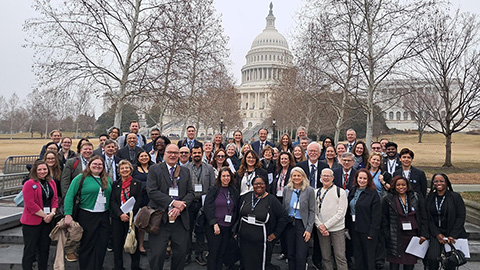
ASBMB members advocate for funding on Capitol Hill
In more than 120 meetings with lawmakers, 50 scientists called for sustained investment in NIH, NSF and DOE research programs.

Women’s health cannot leave rare diseases behind
A physician living with lymphangioleiomyomatosis and a basic scientist explain why patient-driven, trial-ready research is essential to turning momentum into meaningful progress.
Building a stronger future for research funding
Hear from Eric Gascho of the Coalition for Health Funding about federal public health investments, the value of collaboration and how scientists can help shape the future of research funding.
Councilors advocate for science on Capitol Hill
ASBMB Councilors meet with their elected officials to advocate for basic scientific research funding and training the next generation of scientists.

Hope for a cure hangs on research
Amid drastic proposed cuts to biomedical research, rare disease families like Hailey Adkisson’s fight for survival and hope. Without funding, science can’t “catch up” to help the patients who need it most.

Supporting science through advocacy and community building
ASBMB calls on scientists to take action as funding cuts and policy shifts threaten the U.S. research enterprise, emphasizing the power of community advocacy and persistence in protecting the future of science.