
In memoriam: Stuart A. Kornfeld
Stuart Arthur Kornfeld, a physician–scientist and educator, died August 17 in St. Louis at 88 from complications of Parkinson’s disease. Kornfeld was the David C. and Betty Farrell Distinguished Professor Emeritus at Washington University School of Medicine. A pioneer in glycobiology, his discoveries transformed cell biology and medicine, and his mentorship shaped generations of physician–scientists. Kornfeld was a member of the American Society for Biochemistry and Molecular Biology for more than 50 years and was awarded the society’s highest honor, the Herb Tabor Award, in 2012.
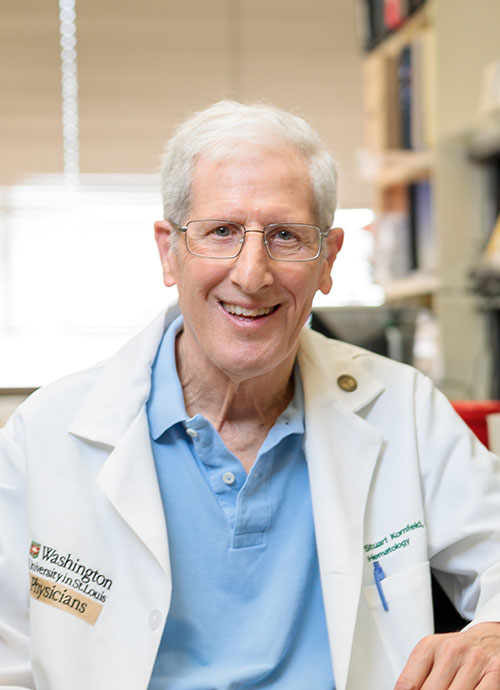
He was born October 4, 1936, in St. Louis to Max and Ruth Kornfeld. His father, a dentist and faculty member at Wash U, nurtured his interest in science. As a student, Kornfeld excelled academically and athletically, captaining his high school basketball and baseball teams. He earned a bachelor’s degree from Dartmouth in 1958 and a medical degree from Washington University in 1962. After completing his residency at the Barnes Jewish Hospital and training at the National Institutes of Health, he joined the Washington University faculty in 1966.
Kornfeld made groundbreaking contributions to the study of glycoproteins, molecules made of sugars attached to proteins that play crucial roles in cell function. His research revealed how sugar chains are built and modified and identified the mechanism by which the mannose-6-phosphate signal that directs enzymes to lysosomes is specifically added to lysosomal enzymes. These discoveries clarified how proteins fold, move within cells and reach their destinations. They also advanced the diagnosis and treatment of lysosomal storage diseases. His work influenced many fields, including genetics, metabolism, immunology, microbiology and oncology.
Much of his research was done with his wife, Rosalind Hauk Kornfeld, a fellow scientist and professor at Wash U. Together they helped lead the field of glycobiology, publishing numerous foundational papers, including one cited more than 4,500 times. Rosalind died in 2007 after 48 years of marriage.
Over his career, Kornfeld published more than 250 papers and held continuous NIH funding for five decades. In 2018, he co-founded M6P Therapeutics, a biotechnology company developing enzyme replacement therapies for lysosomal storage diseases such as Tay–Sachs, Gaucher, Pompe and mucopolysaccharidosis.
In addition to his research, Kornfeld was dedicated to training physician–scientists. He also co-directed the Division of Hematology–Oncology from 1976 to 1992 and the Division of Hematology from 1993 to 2009. He was elected to the National Academy of Sciences, the National Academy of Medicine and the American Academy of Arts and Sciences. His honors included the Passano Award, the Kober Medal, the E.B. Wilson Medal and Washington University’s Distinguished Faculty Award.
He is survived by his daughter Katherine Kornfeld; his son, Kerry Kornfeld; six grandchildren; and two great-grandchildren. He was preceded in death by his daughter Carolyn Kornfeld Lesorogol.
A lifelong St. Louis Cardinals fan, Kornfeld also enjoyed tennis, golf and supporting the city’s cultural institutions.
“Stu Kornfeld was that rare bird in science who, without exhibiting an ounce of self-promotion, made foundational contributions that are embedded within every biochemistry and cell biology textbook,” Brian “Binks” Wattenberg, a professor of cellular, molecular and genetic medicine at Virginia Commonwealth University, said. “His dry wit was legendary, his eye for the key experiment was unerring, his devotion to basic science was, and is, a widespread inspiration.”
Enjoy reading ASBMB Today?
Become a member to receive the print edition four times a year and the digital edition monthly.
Learn moreGet the latest from ASBMB Today
Enter your email address, and we’ll send you a weekly email with recent articles, interviews and more.
Latest in People
People highlights or most popular articles
de la Fuente honored for AI research
The award will support the development of an AI system called ApexMol, a 3D structure–informed, agentic large language model designed to create new biomolecules.
In memoriam: Peter Roepstorff
He was a leading researcher in biological mass spectrometry, mapped protein function in living organisms and was an ASBMB member for 19 years.
Flipping lipids and slime molds
A dull first job nearly pushed JBC associate editor Todd Graham out of science. Then a slime mold project changed his path. Now, he studies membrane biology and reflects on discovery, persistence and mentoring through uncertainty.
ASBMB members receive RNA Society awards
The RNA Society awards Brenda Bass, Can Cenik and Karin Musier–Forsyth for their achievements in RNA research and innovation. Winners will be recognized at the closing awards ceremony of the RNA 2026 annual meeting.
In memoriam: Richard L. Cross
He studied the enzymatic mechanisms of ATP synthase and served on the editorial board of the Journal of Biological Chemistry for 24 years.
A chance encounter with the lab
Payton Stevens never planned to become a pancreatic cancer researcher. A temporary job set him on a path from rural Kentucky to leading research on Wnt signaling and metastasis, where he now pairs discovery with mentorship and science advocacy.