
Advocacy
Advocacy Training Program
Application deadline: May 3, 11:59 p.m. Eastern Apply now
The ASBMB Advocacy Training program is a three-month externship (May through August) that provides hands-on science policy and advocacy training for ASBMB members. ATP delegates learn about science advocacy, the role of Congress and policymakers in funding science, and how to effectively advocate. With support from ASBMB public affairs staff, delegate will develop and execute their own independent advocacy activity to address an issue affecting the research enterprise and/or their communities.
Participants (called delegates) gain the necessary skills to create change and be a leader for those seeking to do the same. They learn alongside a cohort of their peers who are dedicated to doing the same type of work and access unique networking opportunities. They also learn the importance of policy writing and how to communicate scientific issues to congressional staffers and other diverse audiences.
Goal of the ATP
The ATP aims to (1) provide professional development for our members (2) expand BMB advocacy efforts and (3) increase the connection points between ASBMB members and the public affairs department to spur new advocacy efforts that are relevant to members.
What to expect as an ATP delegate
The program requires about 10 to 12 hours a month for coursework, discussions and activities.
Each delegate attends weekly virtual training sessions (1.5 hours long each), completes applied learning assignments and develops their independent advocacy activity. The syllabus includes the following sessions:
Section One: Science policy, advocacy and the federal government
- Session 1 — What is science policy?
- Session 2 — The executive branch and federal agencies.
- Session 3 — Congressional advocacy, agency authorization and the budget process.
- Session 4 — State and local advocacy and engaging community stakeholders.
Section Two: Science policy strategy
- Session 5 — Science policy writing
- Session 6 — Applying policy writing in advocacy
- Session 7 — Diversity, equity, accessibility and inclusion in advocacy
- Session 8 — Constructing your advocacy message
Section Three: Advocating before, during and after
- Session 9 — Elevator pitch practice
- Session 10 — Exploring science policy careers panel
- Session 11 — ATP showcase
What ATP delegates gain
ATP delegates gain not only advocacy skills but also produce their own policy materials and access unique opportunities. Each delegate:
- Conducts an advocacy activity that matches their interests.
- Speaks with congressional policymakers about relevant science policy topics
- Writes a policy op-ed.
- Attends an exclusive career panel of science policy professionals.
- Gets a chance to be invited to the ASBMB Public Affairs Advisory Committee as a nonvoting member (two-year term).
- Gets the opportunity to present advocacy activities at the next ASBMB annual meeting.
Any questions can be directed to publicaffairs@asbmb.org.
FAQ
Do I have to be an ASBMB member?
Acceptance into the ATP requires an active ASBMB membership. If you’re not already a member, join here.
Which career-stages are eligible to apply?
All career stages between undergraduate students and faculty members are eligible to apply. Though the ATP is tailored to be most impactful for graduate students and postdoctoral scholars, faculty members are also welcome to apply. Due to programmatic limitations, no more than two undergraduate students per ATP cohort will be accepted.
Can green card holders and non-citizens apply?
Yes, you can apply.
What kind and how much homework will there be?
Homework will vary depending on the week. During the first half of the ATP, you’ll read articles, watch videos and complete targeted activities to help you develop your understanding of an issue area of your choice. Examples of each homework assignment will be provided. The second half of the ATP will be spent on larger projects, e.g., elevator pitch and written op-ed or policy memo. Be prepared to dedicate 10–12 hours a month to the program. If you cannot make such a commitment, skip this application period and apply in the following cycle.
What if I miss a session?
Delegates are expected to attend each session to develop the tools needed to become an effective advocate. Because the sessions are virtual, you should be able to attend from any location. Sessions will be scheduled on Wednesday afternoons from 4–5 p.m. Eastern. If you foresee more than three date conflicts, we ask that you do not apply. Note: We will not be meeting the week of the July 4.
Do I have to tell my research adviser/principal investigator that I am applying?
We encourage you to discuss your application and participation in this program with your adviser. If you believe that there will be a conflict between you and your adviser (or other institutional officials), we ask that you not apply.
Do I get to participate in the ASBMB’s Capitol Hill Day in Washington, D.C.?
We're not sure! Following the COVID-19 pandemic, the annual ASBMB Capitol Hill Day has been conducted virtually with our Public Affairs Committee. As the situation evolves and Congress becomes accessible in-person again, this may change.
What do I get out of becoming a delegate?
Our goal is to produce self-motivated, knowledgeable delegates dedicated to advocating for life science research. You will gain skills that you need to create change in your region and to become a leader for those seeking to do the same. You will have a built-in network of at least 10 other delegates around the country dedicated to doing the same type of work, meet and network with expert guest speakers, and learn about career opportunities in science policy.
What happens after it’s over?
Alumni have the opportunity to become teaching assistants for the next cohort, participate in an ATP alumni working group and join ASBMB Public Affairs Advisory Committee working groups. The ASBMB policy team will use alumni feedback to improve the program for the next cohort of delegates. The policy team also will call upon alumni to mobilize their local networks to coordinate national advocacy campaign efforts.
If I don’t become a delegate this year, can I apply the next year?
Yes. Applications are expected to cycle annually. Reach out to publicaffairs@asbmb.org for the latest information.
I’d like to participate in advocacy, but can’t commit that much time to this program. What can I do?
The ASBMB provides a variety of advocacy activities throughout the year. Email publicaffairs@asbmb.org to learn what opportunities might be available, such as writing an article for the ASBMB Today magazine.
Additional resources
Magazine
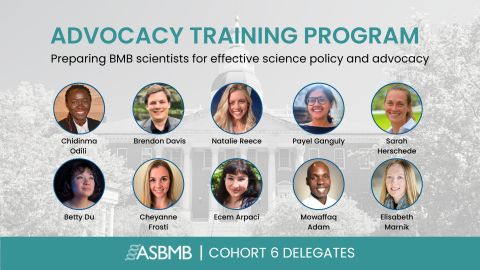
Meet the 2024 ASBMB Advocacy Training Program delegates
The program's sixth cohort will learn how to advocate for science funding and support this summer and will visit Capitol Hill in 2025.
Magazine
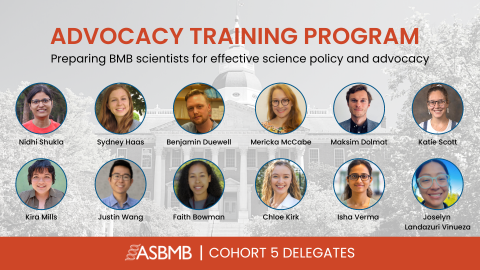
Meet the 2023 ASBMB Advocacy Training Program delegates
ASBMB announces a new cohort of 12 ASBMB Advocacy Training Program delegates who will learn about science policy and advocacy through this summer externship
Magazine
ASBMB delegates leave their mark on policymaking
Advocacy Training Program participants use their new skills to improve their institutional environments, create new programs, draft policy recommendations, perform targeted outreach and more.
Magazine
What we learned in the ATP
Seven members of the first group to complete the ASBMB’s Advocacy Training Program describe their experiences and share what they learned.
Advocacy toolkit
Best practices for sharing your stories with the policymakers whose decisions affect your work.
Magazine
Your voice does matter
Even in these deeply partisan times, grassroots advocacy is effective. As a subject matter expert, you can educate your legislator about the value of science.