
25 years of inspiring
the next generation

A graduate student at the University of Texas Southwestern Medical Center explains to a group of high school students why people in the same family can have straight or curly hair, weaving the central dogma of biology and Mendelian genetics into the explanation. After absorbing the information, one teenager has a lightbulb moment, saying, “Oh, that’s why my grandma has curly hair but the rest of us have straight hair!”
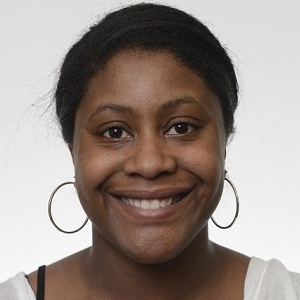
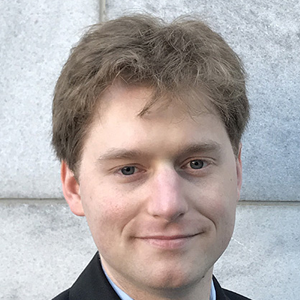
.jpg "HPREP1-(2).jpg") Pictured with adviser Stuart Ravnik (second from right) at the HPREP Science Day at UT Southwestern are the authors of this article, (from left) John Corbett, Amanda Goldner and Brittany Johnson. COURTESY OF STUART RAVNIK
Pictured with adviser Stuart Ravnik (second from right) at the HPREP Science Day at UT Southwestern are the authors of this article, (from left) John Corbett, Amanda Goldner and Brittany Johnson. COURTESY OF STUART RAVNIK
That straight-haired student was one of about 180 Dallas-area high schoolers exposed to information about careers in medicine and biomedical research at the 25th anniversary of the annual Health Professions Recruitment and Exposure Program, or HPREP, at UT Southwestern.
Stuart Ravnik, associate dean of the university’s graduate school and a member of the American Society for Biochemistry and Molecular Biology’s Public Outreach Committee, helps organize the event. “The initial idea was to create hands-on science activities to demonstrate how scientists might address a scientific question,” he said.
Science and medicine originally were covered in a single day, but three years ago the high school students suggested more time be dedicated to science. A committee of three graduate students helped plan Science Day from the start and modified activities to better emulate scientific experiments and to demonstrate important scientific principles, such as hypothesis formulation, data processing and results interpretation. More than 400 high school students from underrepresented backgrounds applied for the program. Participants were selected based on their career interests, according to Dawn Cureton of the Office of Diversity and Inclusion at UT Southwestern.
 Dallas-area high school students look through microscopes, learning about neurological and cardiac histology, during the HPREP Science Day at UT Southwestern.COURTESY OF STUART RAVNIK
The day introduced the students to diverse topics in biomedical science. Genetic inheritance was explained and tested using paper coated with phenylthiocarbamide, or PTC, which tastes bitter to those carrying the dominant gene for PTC tasting, TAS2R38. At another station, graduate students showed mutant phenotypes in fruit flies and zebra fish as examples of model organisms in the lab.
“I’ve never seen anything like this before,” one high school student said. “We learn about genetic differences in our biology class but don’t get firsthand experience of how these differences are expressed.”
To demonstrate visual cortex neuroplasticity, students repeatedly tossed bean bags at a target while wearing a patch over one eye, which altered their perception of the target location and distance. Throws were initially inaccurate, but the high schoolers quickly adapted to the eye patch and soon matched their two-eyed proficiency.
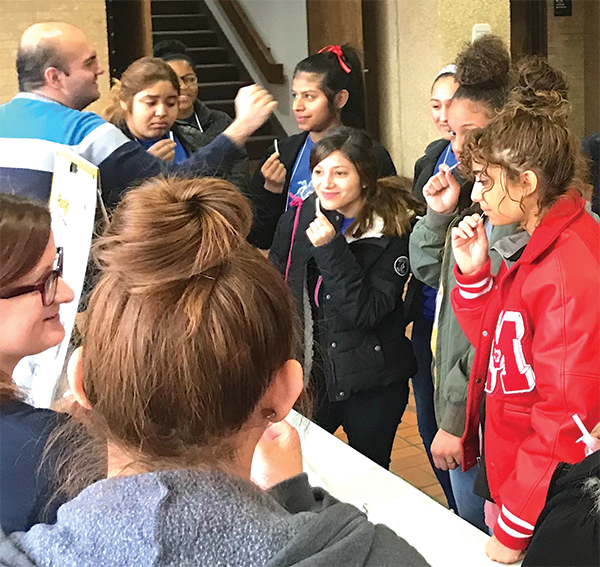 Dallas-area high school students taste phenylthiocarbamide paper to determine whether they carry the dominant gene for PTC tasting, TAS2R38, during the HPREP Science Day at UT Southwestern.COURTESY OF STUART RAVNIK
Nora-Guadalupe Ramirez was one of the graduate student coordinators. “The goal of Science Day is to give meaningful glimpses into the different topics and techniques used in biomedical research,” she said. “We wanted to ensure more hands-on activities in order for the students to get a feel for research and also understand how each technique can be used to answer impactful questions.”
Planning for next year’s Science Day already has begun. Organizers expect even more applicants and believe exposing more high school students to science will motivate more individuals from underrepresented groups to pursue careers in biomedical research and related fields.
Enjoy reading ASBMB Today?
Become a member to receive the print edition four times a year and the digital edition monthly.
Learn moreGet the latest from ASBMB Today
Enter your email address, and we’ll send you a weekly email with recent articles, interviews and more.
Latest in People
People highlights or most popular articles
Uncovering the molecular roots of fatty liver disease
Physician–scientist Silvia Sookoian discusses her path from hepatitis C care to MASLD research, her use of multi-omics to study steatotic liver disease, and how lipid metabolism and genetics are reshaping understanding of MASH and liver health.
Kimble honored for lifetime achievement in genetics
She received the 2026 Thomas Hunt Morgan Medal and will be honored with a dedicated online profile and seminar.
Janetka named distinguished professor
Washington University awarded him the inaugural Carl Frieden Distinguished Professorship.
ASBMB members receive ASPET awards
The American Society for Pharmacology and Experimental Therapeutics awards Simone Brixius–Anderko, Paul Insel, Sudarshan Rajagopal, Emily Scott, Alan Smrcka and Jürgen Wess for their excellent research and mentoring work in pharmacology.
Kozul honored by Washington University
She received the 2025 Elliot L. Elson Education and Training Award.
de la Fuente honored for AI research
The award will support the development of an AI system called ApexMol, a 3D structure–informed, agentic large language model designed to create new biomolecules.