
Pushing myself to explore Maine
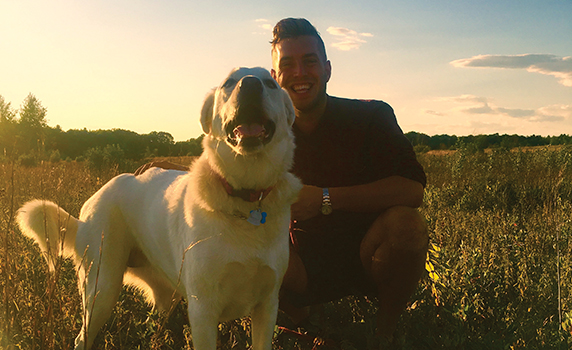 Scarneo and his dog, Koda, in a wild blueberry field in Maine.PHOTO PROVIDED BY SCOTT SCARNEO
43.4742 N, 70.4461 W is where I found myself as a graduate student studying neurobiology. I can’t say the cold state of Maine was my first choice of graduate school location. However, the never-ending pursuit of knowledge swayed me enough to relocate.
Most graduate students are less interested in the location of the school than in the promise and advancement of our skills and intelligence. I mean, for most of the week, we hardly have any time to enjoy our new location.
I know this may not be popular advice with some principal investigators, but I’ll say it: Graduate students, make the time to get out of the lab. I mean it. Don’t be that kid who is cooped up in the lab 24/7 worrying if his or her PCR will be perfect. Don’t get me wrong: I am partial to a nice PCR, but the point is to get out and enjoy your local area even if, like me, it isn’t your first choice of dwelling.
When I arrived in the state of Maine, I was happy to find out I had my fair share of work to occupy me in the lab. I worked all day and went home when the sun was setting, in a mental state too useless to get out and explore.
However, I found that getting out of my comfort zone and making time to immerse myself in the local culture became essential to my success in the program. I know this may sound silly, and I’m worried even to write it here, but in getting to know the local area better, I made a checklist of things I wanted to complete while living in Maine:
1) Eat a lobster roll. I guess this one is self-explanatory. They sell lobsters at most gas stations in the state.
2) Go whitewater rafting and camping. Why not get adventurous?
3) See a moose. I’m not talking about one in a zoo. More like a full-on moose crossing the road or in a bog somewhere.
A little more than seven months later, I am proud to say I have done the first two out of the three items on my list. The moose have eluded me so far. I will admit that after, and only after, I pushed myself to explore the state, I truly became comfortable and began to enjoy my stay in my new home.
My advice to any graduate student out there who is in a new location is to make the time to push yourself and explore your new surroundings. You never know what you may find!
Enjoy reading ASBMB Today?
Become a member to receive the print edition four times a year and the digital edition monthly.
Learn moreGet the latest from ASBMB Today
Enter your email address, and we’ll send you a weekly email with recent articles, interviews and more.
Latest in Opinions
Opinions highlights or most popular articles
Learning can be fun: Gaming anatomy and physiology
Instructors explore how gamification and active learning transform student engagement and retention. They convey how emotion, interaction and design can make even rigorous subjects more effective and memorable.
Mentorship and uncertainty: Lessons from Telemachus
A biochemistry educator reflects on mentorship through the Greek story of Telemachus, showing how embracing uncertainty, failure and curiosity can transform teaching.
Embracing the twists and turns along the educator pathway
A biochemistry educator reflects on the challenges of early faculty life, describing how evidence-based teaching, cross-disciplinary collaboration and classroom challenges shaped her growth.
Redesigning with students in mind
Assistant professor reflects on how the shift to online teaching revealed gaps in points-based grading and led to a redesign centered on transparency and student growth.
Teaching beyond information transfer
Educator reflects on moving beyond lectures to create a biochemistry classroom centered on engagement, transparency and student ownership, showing how small shifts like “student hours” and active learning can transform understanding.
Mayday! Lessons from cellular dysfunction and group work dynamics
An upper-level biology course revealed that strong science doesn’t guarantee strong teamwork. One instructor shares how failed group dynamics reshaped their approach, leading to more structured, collaborative and effective student learning.