
Designing a career in science and art
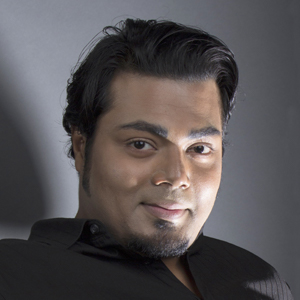
Something was missing. Several years ago, I felt its absence growing. It was beginning to drive me insane.
After getting a M.Sc. in bioinformatics, I worked as a research fellow for a year and then became a joint Ph.D. student of math and medical oncology before landing a postdoc doing cancer research. I was living a conventional life of science — becoming a character straight out of the show “The Big Bang Theory.”
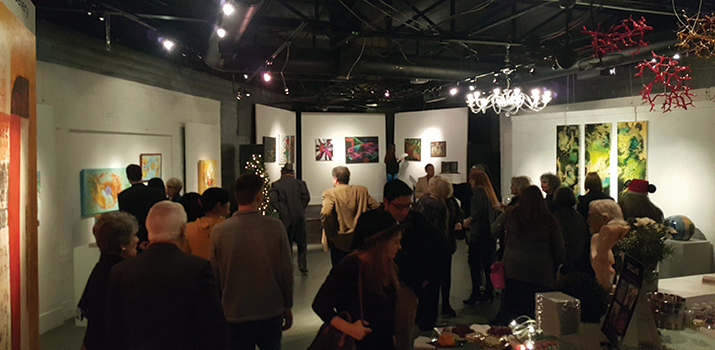 Artworks by the members of the Cancer ART-SCI network in the LuminArté gallery in Dallas, Texas.PHOTOS PROVIDED BY DEB
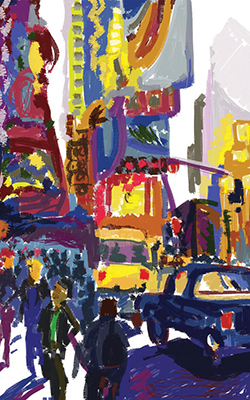 Early example of Deb’s art.
But there was another part of me, an artistic side. I’d practiced studio-based art throughout my childhood and loved it. But during my scientific journey, the artist in me had become stifled by the solid bars of reproducibility, statistical significance and peer-reviewed publications. Over time, my vital connection to art had been reduced to a hobby.
In 2011, I lost my mother to an aggressive brain cancer. The pain and anguish of that loss made me think hard about the purpose of my life. It was then that it came to me that I love science and want to keep working on cancer research. But I also love art. Could there be a way to combine these passions?
Would it be possible to put scientific methodologies together with artistic practices and still advance prevention, diagnosis or a cure for cancer?
Maybe, I thought, I could pursue the “how” of cancer in the lab during the day and the “why” of cancer in the studio during the night. But how?
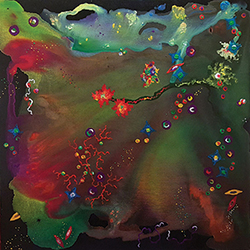 “Hallmarks of cancer” created by Deb.
Finding cancer scientist–artists
I started looking into existing art-science collaborative projects and searching for people trained in both scientific research and artistic practices. Although I found that there were many scientists and artists involved in various types of collaborations, there were few cancer scientist-artists like me interested in using artistic processes to do better cancer research in addition to simply making art about cancer.
There was a plethora of work on art therapy and science outreach related to cancer. There were many examples of cancer data visualization too. But back then none of them rigorously combined scientific methodologies with artistic practices to generate novel research ideas or propose solutions for the crucial problems faced by cancer researchers when real-life data were not available.
One such problem is the variability of cancer cells. Even within one tumor, there can be cells with different biological properties and therapeutic implications. When I apply techniques of visual art, such as divergent thinking, to this problem, I can come up with a conceptual model for studying all the biological properties (known as the ten hallmarks of cancer) of tumors at the single-cell level. For me, an essential part of this creative idea generation process is the visualization of such a conceptual model in drawing and painting.
Was it possible that on the other side of the planet someone was thinking just like me? I began to envision a network that would bring together cancer scientist-artists from around the world.
During this time, I also was taking a leadership course aimed at boosting communication skills. As part of my homework, I researched executive editors, founders, directors and CEOs of professional societies, nonprofits and academic journals interested in merging art and science. I made a list of people that I was interested in speaking with about the project and reached out to them.
Cynthia Pannucci, the founder and director of Art & Science Collaborations, or ASCI, in New York City, was the first to reply. She not only encouraged my idea of a cancer, art and science group, which I would go on to name the Cancer ART-SCI Network, but also connected me with Roger Malina, the executive editor of an art and science journal called Leonardo. Malina liked my idea. I published a peer-reviewed article in Leonardo called “Understanding the unpredictability of cancer using chaos theory and modern art techniques.” Response was positive, and I proposed an “ art and cancer” special section in Leonardo. Malina agreed on the condition that I be the guest editor and form an editorial advisory committee. The special section aims to document studies where scientific methodologies combined with artistic practices could advance prevention, diagnosis or cure for cancer.
By the time the Leonardo special section was underway, I had made contact with about 10 other scientist-artists who shared my vision. Now that there was a publication willing to cover the intersection of cancer research and art, how could I grow this small network? Was there a way to reach out to cancer scientist-artists worldwide?
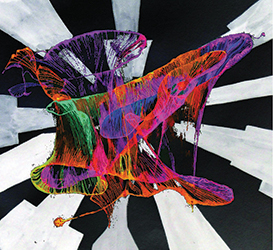 “Strange attractor of cancer in its phase space” created by Deb in 2015.
Expanding the network
In 2013, I was giving an award lecture about my work on identifying novel therapeutic targets in lung cancer at the Memorial Sloan-Kettering Cancer Center in New York. The talk was on the same day as the Leonardo Art Science Evening Rendezvous seminar, which goes by the acronym LASER, in New York City. I spoke to the organizers of LASER, and they agreed to let me present my cancer-art collaborative work at the seminar.
I literally carried two bags on my shoulder that day — one from the science conference and the other from the art event. The LASER meeting got me a lot of new contacts in New York City. In addition, I was interviewed by the online magazine Sci-Art in America and got featured by ASCI. Soon after, I recorded a podcast on our growing network of cancer researchers and artists at the University of Texas at Dallas and was invited to a meeting arranged by the National Academies on combining art, science, engineering and medicine.
The Cancer ART-SCI Network started getting international attention. Le Scienze in Italy and MedInArt in Greece featured an ongoing visual art project we produced called “Cancer: Finding Beauty in the Beast,” on their websites.
I recently curated and participated in a gallery installation to show the works of art created by the members of Cancer ART-SCI Network. It involved paintings, sculptures and photography created by six scientists and artists.
Loving life
Now I am living a life that I love. I am a scientist by day and an artist at night. I would like to stay that way. In the future, if I’m offered the chance to practice both as part of one job, I will take it.
The Cancer ART-SCI Network is a fast-growing community, and it already has members from several countries around the world. At some point, I may create a nonprofit organization to manage its burgeoning activities.
I feel this is just the beginning of a fulfilled life.
Enjoy reading ASBMB Today?
Become a member to receive the print edition four times a year and the digital edition monthly.
Learn moreGet the latest from ASBMB Today
Enter your email address, and we’ll send you a weekly email with recent articles, interviews and more.
Latest in Opinions
Opinions highlights or most popular articles
Learning can be fun: Gaming anatomy and physiology
Instructors explore how gamification and active learning transform student engagement and retention. They convey how emotion, interaction and design can make even rigorous subjects more effective and memorable.
Mentorship and uncertainty: Lessons from Telemachus
A biochemistry educator reflects on mentorship through the Greek story of Telemachus, showing how embracing uncertainty, failure and curiosity can transform teaching.
Embracing the twists and turns along the educator pathway
A biochemistry educator reflects on the challenges of early faculty life, describing how evidence-based teaching, cross-disciplinary collaboration and classroom challenges shaped her growth.
Redesigning with students in mind
Assistant professor reflects on how the shift to online teaching revealed gaps in points-based grading and led to a redesign centered on transparency and student growth.
Teaching beyond information transfer
Educator reflects on moving beyond lectures to create a biochemistry classroom centered on engagement, transparency and student ownership, showing how small shifts like “student hours” and active learning can transform understanding.
Mayday! Lessons from cellular dysfunction and group work dynamics
An upper-level biology course revealed that strong science doesn’t guarantee strong teamwork. One instructor shares how failed group dynamics reshaped their approach, leading to more structured, collaborative and effective student learning.