
Regeneration of a transgenic mouse model

Nicole Ward came upon her psoriasis mouse serendipitously. Ward, an associate professor in the department of dermatology at Case Western Reserve University, was working in the department of anatomy there when she discovered the mouse. A neuroscientist by training, she was studying how nerves and blood vessels influence each other’s development. Ward was using a transgenic mouse line, the keratinocyte-Tie2 or KC-Tie2 mouse, to manipulate cells in the skin and study how they changed the surrounding blood vessels and nerves. She noticed that the skin of these mice was patchy red and scaly like that of her father, who suffers from psoriasis.
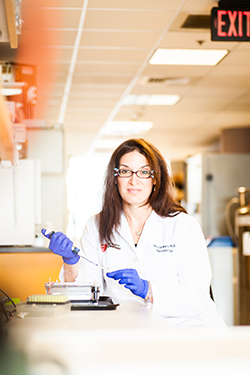 Nicole Ward
Ward’s office happened to be across the hall from faculty members in the dermatology department, and she interacted with them every day. After two years with the anatomy department, she joined the dermatology department, moved across the hall and started characterizing the mouse she was using to study nerve development as a model of psoriasis.
The KC-Tie2 mouse is a remarkably accurate model of psoriasis. Ward and her research team showed that the skin disease developed by the mouse is very similar to human psoriasis physically and biochemically. The mouse also responds to drugs that work in patients and, more impressively, does not respond to drugs that do not work in patients.
“Most of the time when people are testing their models against human disease, they just make sure that the drugs that work in patients work in their mouse model. We’re really aware that it’s equally important to demonstrate that drugs that have failed in clinical trials, that don’t improve
the patient’s disease, also fail in the mouse model,” Ward says. “So this mouse has been able to do that.”
Results from the KC-Tie2 mouse have been translatable to psoriasis patients. Ward’s latest findings were recently published in the journal Molecular & Cellular Proteomics. See a related story in the Journal News section of this issue.
Because the KC-Tie2 mouse was developed originally to study nerve development, the fact that it developed psoriasis suggested a connection between the two. This link has been observed anecdotally in psoriasis patients who have undergone knee surgery. After the procedure, “the (psoriasis) plaque on the knee that was operated on goes away so there was speculation among the clinical dermatologists that perhaps the nervous system was contributing to the disease,” explains Ward. “There are other similar reports of injury to the nervous system and then remission of the psoriasis in the areas where the nerves had been damaged.”
To elucidate the basis for these observations, Ward and her team surgically removed the nerves from the skin of the KC-Tie2 mouse, and the psoriasis improved. After figuring out that certain neural peptides were elevated in the psoriatic skin, they removed the nerves in the skin and put back only the peptides. The psoriasis returned. To verify the causal role of the peptides, they kept the nerves in the skin but blocked the release of the peptides, and again the disease went away.
Since Ward moved across the hall in 2005, she has been investigating psoriasis and skin inflammation full-time. Ward has not left behind her neuroscience roots, though.
“I’m lucky I get to play a little bit in the neuroscience sandbox because psoriasis is a very cool disease if you’re studying disease pathogenesis. You have so many cell types that are contributing to the inflammation. You have the keratinocytes, the nerves, the blood vessels and all those immune cells,” she says. “I always tell patients when I’m talking to them, ‘You know, the disease is absolutely fascinating at the scientific level.’ It’s like a big, ginormous nerd alert, right? But it’s like so, so cool.”
Enjoy reading ASBMB Today?
Become a member to receive the print edition four times a year and the digital edition monthly.
Learn moreGet the latest from ASBMB Today
Enter your email address, and we’ll send you a weekly email with recent articles, interviews and more.
Latest in Opinions
Opinions highlights or most popular articles
Learning can be fun: Gaming anatomy and physiology
Instructors explore how gamification and active learning transform student engagement and retention. They convey how emotion, interaction and design can make even rigorous subjects more effective and memorable.
Mentorship and uncertainty: Lessons from Telemachus
A biochemistry educator reflects on mentorship through the Greek story of Telemachus, showing how embracing uncertainty, failure and curiosity can transform teaching.
Embracing the twists and turns along the educator pathway
A biochemistry educator reflects on the challenges of early faculty life, describing how evidence-based teaching, cross-disciplinary collaboration and classroom challenges shaped her growth.
Redesigning with students in mind
Assistant professor reflects on how the shift to online teaching revealed gaps in points-based grading and led to a redesign centered on transparency and student growth.
Teaching beyond information transfer
Educator reflects on moving beyond lectures to create a biochemistry classroom centered on engagement, transparency and student ownership, showing how small shifts like “student hours” and active learning can transform understanding.
Mayday! Lessons from cellular dysfunction and group work dynamics
An upper-level biology course revealed that strong science doesn’t guarantee strong teamwork. One instructor shares how failed group dynamics reshaped their approach, leading to more structured, collaborative and effective student learning.